
DSRF UK continues to be concerned about the topic of Assisted Dying and the Down syndrome community, and we’d like to share some practical steps we have been taking to move knowledge forwards in this area.
As of March 2026, it remains to be seen whether Kim Leadbeater’s Assisted Dying Bill will pass or fall. The Bill has been making its’ way through the Houses of Parliament and the House of Lords over the last year and a half, prompting many people and organisations to think deeply about the repercussions of legalised assisted dying. DSRF UK has voiced concerns on behalf of people with intellectual disabilities, including those with Down syndrome. We also spoke out in relation to the McArthur Bill in Scotland, and it has been reassuring to see Members of the Scottish Parliament take the concerns of the Scottish people seriously, eventually voting against the proposed Bill at the last stage.
Issues of consent, and concerns for the protection of human rights have been at the forefront of our minds. Although assisted dying has been introduced in many jurisdictions around the world, we still know almost nothing about the impact such laws have had on people with intellectual disabilities, whether as a distinct group, or as pertains to individuals. Data on this is either inaccessible or non-existent. We have encountered some deeply worrying presumptions in the draft Bill about how safeguarding for people with intellectual disabilities will be implemented, sitting alongside an absence of guiding data on the reality from other countries.
With the Leadbeater Bill, the cautious approach of increasing safeguards in the Bill has been rejected. Instead, we’ve heard that failing to offer Assisted Dying services due to intellectual disability would be a breach of equality laws. The draft Bill explicitly requires the Secretary of State to consult people with learning disabilities before issuing guidance, but currently, no research exists on how people with learning disabilities understand assisted dying, what influences their views, or how to discuss the topic without coercion.
The reality is: this is uncharted territory. Even in countries where these issues have already been encountered, we have seen no roadmaps drawn up for navigation through this ethical minefield.
It is more important than ever that people with intellectual disabilities are invited to be involved in the debate. Decisions about assisted dying are irreversible, so society as a whole needs to understand their specific needs with regards to decision making, influences, and coercion concerns.
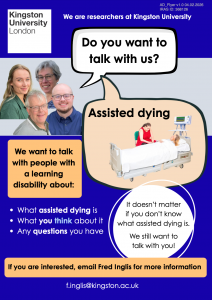
Alongside Mencap, we are supporting the research of the KIND research team at Kingston University, led by Professor Irene Tuffrey-Wijne, as they carry out a pilot study on this subject. This pilot project asks what people with a learning disability understand and think about assisted dying, and what their questions and worries are about it.
Professor Irene Tuffrey-Wijne is the world’s first professor of Intellectual Disability and Palliative Care, with many years of experience exploring end of life issues, and co-producing research with a team of experts by experience. We can’t think of a group better equipped to ask some of these questions: concerns we have heard repeated often by individuals, families and professionals. We are confident that this team will do a rigorous job of exploring this extremely difficult and sensitive topic with objectivity and honesty.
Please share the Fliers here: Assisted Dying Study – Flyer – V1 2
The results of the study are expected by late summer, and a webinar series to present the results has been scheduled to begin on 11th September 2026. You can find the QR code to register for this meeting plus more details on the social media post here.