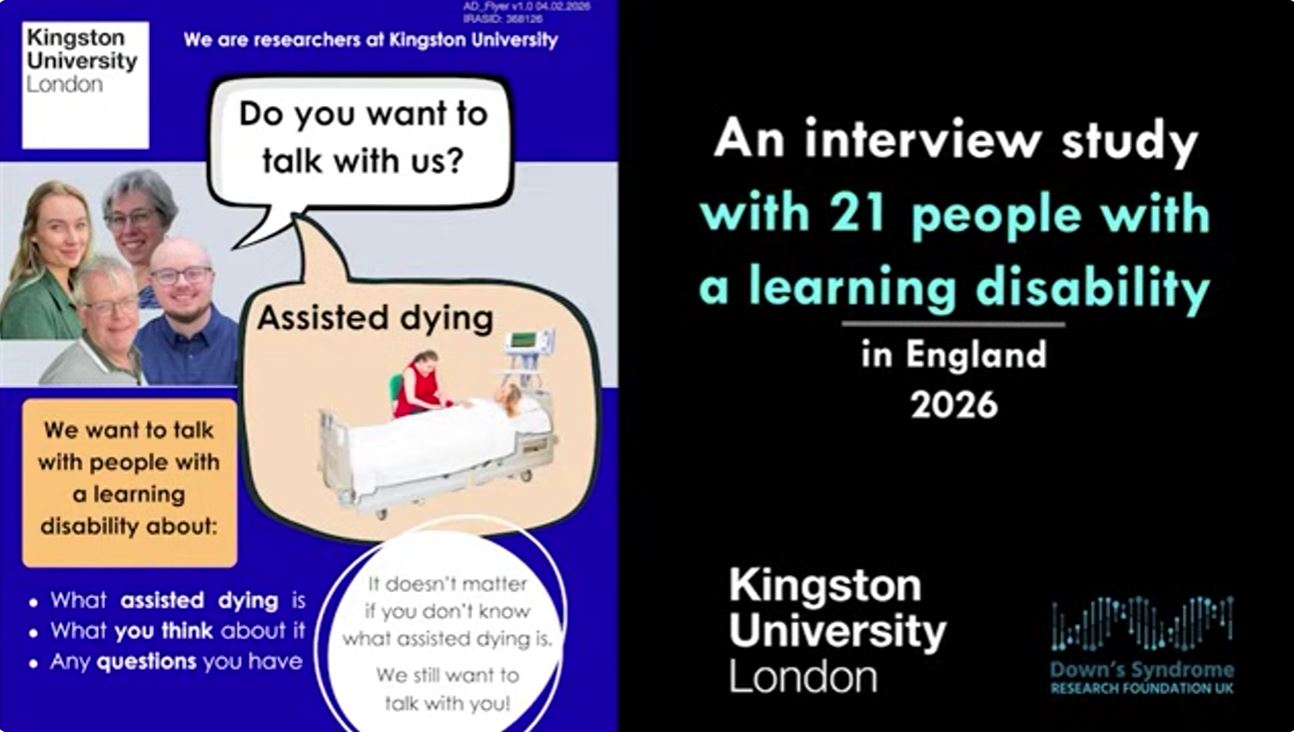
We highly encourage followers to watch the 8th September 2026 webinar and researcher reflections on the findings of a recent study ‘The impact of assisted dying legislation on people with a learning disability’ from Kingston University London KIND Research Group, led by Professor Irene Tuffrey-Wijne.
This research has been carried out to explore the implications of assisted dying legislation on people with an intellectual disability. It involved extensive first-hand input from the perspective of 21 interviewees who have intellectual disabilities.
1.What was unique about this research?
It’s the first research project in the world that has asked people with intellectual disabilities what they think and understand about assisted dying. That is well overdue, since in other countries which have legalised it, people with intellectual disabilities have been eligible to decide on assisted dying for up to decades.
2. Why is it so important right now?
The Edwards Assisted Dying Bill is about to be voted on in Parliament on Friday 11th September 2026 – two days from now.
This research highlights many serious issues that would directly affect the Down syndrome community, as it faces the new possibilities arising with Assisted Dying legislation.
Some of these issues are particularly concerning, given the form and limitations of the Edwards Bill.
3. What did the research ask participants with intellectual disabilities?
- Why might someone want assisted dying or not want assisted dying?
- What are your questions and worries about assisted dying?
- How would you make decisions about assisted dying?
- What information do the people with a learning disability need about assisted dying?
4. What was the profile of the research participants?
The interviewees all had intellectual disabilities. A number were already involved in self-advocacy, and could be assumed to have good or adequate capacity to process the information involved.
5. What did the research assume?
Researchers assumed that equality means people with intellectual disabilities should not be barred from assisted dying, but that there’s a need to ascertain how complete and free the choice would be, and how we could ensure that it was a personal decision.
6. What did interviewees understand about assisted dying?
From the webinar:
“We asked … if you can explain what assisted dying is.”
… Eight people said they didn’t know.
Fiona: “No one has told me about it or make me understand about it.”
Very few people had a full understanding.
Alice: “If someone feels like they’re not living the life that they want, they’ve decided to ask somebody to help them die.”
Even those who seemed to understand it often didn’t grasp that it had to be the person’s own choice, even after we had explained this.
Alice: “To people with learning disabilities, assisted dying was done without consent in the hospitals during COVID.”
Caroline: “Like Michael Jackson. The doctor helped Michael Jackson to die.”
… Some people misunderstood the word ‘assisted’.
Jeff: “My uncle had assisted dying. He went into the hospice. They helped him along his way. They tried to make him as comfortable as possible.”
7. What did the research group find surprising about the results?
- There was a lack of understanding in many instances about what assisted dying meant, and even that it was a final decision that couldn’t be reversed. After discussing it, research participants thought it was important that others should be informed about this reality.
- Research participants wanted Easy Read information on Assisted Dying, but they equally wanted accessible information on about Natural Dying too.
- However, improved provision of information wouldn’t determine their decision: instead research participants generally indicated that they would turn to their family and friends for their input on the ‘right’ decision.
- Participants didn’t experience enough autonomy to believe they could independently choose what they wanted regarding assisted dying, but indicated they would defer to the people who knew them, or the knowledge of professionals.
- Even self advocates in the group who campaigned for choice in other matters didn’t see Assisted Dying as a request arising out of their own choice – it seemed ‘too big’ for them.
- This issue wasn’t framed by participants as being able to decide on or control the manner of their own death, but responses showed a basic uncertainty about having permission to decide on issues that big.
From the webinar:
… some people were really struck by the irreversibility of assisted dying. We asked what they thought people needed to know most about assisted dying.
Ellie: That you die immediately, and it is not possible to change your mind.
It’s not a telly death. They have to know that they’re not actors. That if they do assisted dying, that they don’t like shout, “Cut!”
Jessica
Almost everyone said that people with a learning disability need information about assisted dying, and that information should be in easy read format. But they also wanted clear information about the alternative to assisted dying.
Aaron: Give him some options. Choice one, choice two. What would happen if we get choice one? What would happen if we get choice two? Explain also in the same way, dying naturally, because in both cases it has to be understood.
But almost everyone also said that others would need to help them decide, or even make the decision for them.
Caroline: He needs help with decisions. He would probably speak to his mom and father and say, “Oh, do you think I should die now or should I die later?”
Jessica: People with learning disabilities can be massively influenced and people pleasers. We say yes just to get us off our back because we don’t like questions, because we worry about answering the question is right or not, because that’s the way we are. Are you okay? Yes. Just say yes because we don’t want to bother people. Just say you’re fine, and they leave you alone.
George: I think the doctor knows a lot more than what we do because they’re the experts after all, aren’t they? But at the same time, it’s what the family think.
Jessica: Even if they take the parents out of the room, they still think, “I’ve got to say this because that’s what my mom would say, or that’s what my mom would want me to say.”
8. What do the research findings imply
- The research participants weren’t motivated by considering Assisted Dying spontaneously – but if a choice was given, they were inclined to let others make it for them, while not fully realising the consequences.
- This raises very serious questions around risks of coercion and undue influence.
- It also strongly indicated that the Mental Capacity Act is unreliable as a framework, as it would weigh what people know, but not account for how they operate.
- Existing patterns mean people currently don’t have the necessary practice and experience to make life-and-death decisions like this, when they already don’t decide on much smaller matters in their lives.
- The research appeared to imply that people with intellectual disabilities are typically handing over bigger decisions over as ‘best interest’ decisions, to families, carers and medical professionals.
9. What sensitive points need to be considered?
- Resources to explain assisted dying must take care to explain the alternative (natural death) fully and clearly too, to avoid leading towards one option over the other.
- The influence of significant people and professionals in the life of someone with intellectual disabilities is very profound and might be substituted for autonomous choices.
- Small differences in language and choosing the right words make a striking difference to the meaning. Anyone involved in communications around assisted dying must fully appreciate this, as even experts in this area are finding challenges phrasing the issue non-coercively and aiding autonomy.
We commend the KIND team at Kingston University for their exceptional willingness to ask these difficult questions, and for their exemplary commitment to coproduction and self advocacy. In particular, we thank all the participants in the research who have shared insights that we really need to be aware of.