
Webinar: New Technology Research in Down’s Syndrome
Investigating Potential Language and Quality of Life Improvements
Yesterday we ran another successful Researcher Chat with Dr. Paolo Cassano, who is Principal Investigator on a new Foundation funded study. Dr Cassano is assistant professor of psychiatry at Harvard Medical School and Director of Photobiomodulation at the Massachusetts General Hospital (MGH) Depression and Clinical Research Program and Principal Investigator at the MGH Center for Anxiety and Traumatic Stress Disorders.

Dr Cassano told us more about an exciting new technology and what conditions photobiomodulation (PBM) has shown promise for. Our Foundation chair, Dr Corcoran, explored the new study investigating PBM for language in adults with DS.
Studies like this are only possible with your support and funding. Please consider making a one off or regular donation.
To learn more about the study contact call 617-724-4539 or email pbm@mgh.harvard.edu or see their Facebook page.
Watch the Facebook live here.
Photo credit: https://giving.massgeneral.org/…/infrared-light…/
Queen Signs Historic Down Syndrome Bill into Law
Yesterday the Queen signed into law an Act of Parliament focussed on improving outcomes for people with Down syndrome and their families. The new ‘Down Syndrome Act 2022’ is understood to be the first of its kind in the world.
The Rt Hon Dr Liam Fox MP, a former NHS Doctor and GP, introduced the ‘Down Syndrome Bill’, as his choice of Private Members’ Bill after he successfully secured a Ballot Bill in the House of Commons this session. Dr Fox broke the news today on his social media accounts that the Queen had given her assent to his Bill, making it law.
It is rare for a Private Members’ Bill to become law. Dr Fox, an MP for some thirty years, secured both cross-party and Government support. As a result, the Down Syndrome Bill passed through both the House of Commons and the House of Lords without objection. Previous attempts by other members of Parliament to bring forward Bills with a broader remit around learning disability have failed.
An open letter was published last month by the National Down Syndrome Policy Group (NDSPG) who have championed the Bill. The open letter urging members of the House of Lords to ensure that the Bill completed its passage had the support of over a hundred organisations including Mencap.
The Down Syndrome Act will come into immediate force and there will now be a public consultation undertaken by the Government to inform development of the necessary guidance for public bodies.
Dr Liam Fox MP, the Down Syndrome Bill Sponsor said:
Tommy Jessop, actor from BBC’s Line of Duty crime drama and NDSPG Ambassador said:
Peter Brackett, Chair of the NDSPG said:
For more information, see the National Down Syndrome Policy Group website ndspg.org or email contact@ndspg.org
For media interviews with Dr Fox please contact David Goss goss@parliament.ukor call 07972 790445
For interviews contact:
- Ken & Rachael Ross MBE on 07710 612 807 kenross@portsmouthdsa.org
rachaelross@portsmouthdsa.org - Lynn Murray on 07840 966736 or email murray@dspg.uk
- Peter Brackett on 07515 121733 brackett@dspg.uk
Down Syndrome Bill https://publications.
Successful Private Members’ Bills since 1983 https://
Down’s syndrome legislation ‘gives people a voice’ https://www.bbc.co.uk/news/uk-
‘Historic’ moment as support for people with Down’s Syndrome written into law https://www.telegraph.co.uk/
People with Down syndrome who are trustees of the Down Syndrome Policy Group welcome the introduction of the Down Syndrome Bill: Launch of The Down Syndrome Bill – YouTube
‘It’s time for us to live our lives to the full’: Line of Duty’s Tommy Jessop on changing the world for people with Down’s syndrome https://www.theguardian.com/
NDSPG Open letter in support for the Down Syndrome Bill https://ndspg.org/media/
Prenatal Testing, Disability, and the Ethical Society: Reflections following Crowter
Dr Eve Hirst
‘Prenatal Testing, Disability and the Ethical Society: Reflections following Crowter’ conference was hosted by Oxford university last week. If you are not familiar with the Crowter case, it was a case brought to the high court by Heidi Crowter, Máire Lea-Wilson and her son Aiden Lea-Wilson in July 2021 to change the law that currently allows for abortion up until birth in the case of disability. Heidi, who has Down Syndrome, said about the current law: ‘What it says to me is that my life isn’t as valuable as others, and I don’t think that’s right. I think it’s downright discrimination!’. Find out more about the case with an easy-read version here.ER DD
During the two-day conference, we heard from several people with different backgrounds – some legal, some ethical, some medical and some with personal experience of the way that the current law has affected them. There were opportunities to ask questions of Heidi Crowter and the other claimants in the case. A panel discussion explored the patient-clinician dynamic, a relationship that is key to women’s experience in pregnancy. Some of the themes discussed were upsetting and a couple are described in brief below.

Dr Marie Tidball, Founding director and coordinator of the Oxford University Disability Law and Policy Project
Many brilliant points were made but several moments stood out to me. The first was hearing from Heidi Crowter about the moment she first learned of the law she is now fighting to change. She poignantly said, ‘I do like doing the court case, but I find it upsetting that I have to’ and later described how it affects many of her peers in the same way. Further to this, Dr Marie Tidball described the obstacles in the system that she had to overcome during pregnancy due to the lack of a ‘Disability Inclusive Maternity Care Pathway’(1).

James and Heidi Carter (nee Crowter), campaigners
A similar theme was continued by Dr Sarah Conrad Sours who described how poor heart surgery outcomes were seen in children with Down Syndrome in the US in the 1970’s due to delayed referral for surgery. These poor outcomes were attributed to the children having Down Syndrome, rather than the delay. As a result of this misconception, surgery was delayed even further, resulting in even poorer outcomes. Nowadays, this delay has been rectified and outcomes have significantly improved(2). As a doctor, I wonder whether there are similar modern-day examples that would explain the poorer health outcomes seen in people with disabilities today.
As the sister of two siblings with Down Syndrome who were adopted, I resonate completely with what Heidi’s husband, James, said during the conference about his (adoptive) family: ‘they absolutely love me and adore me.’ And so do more than 96% of families that have a family member with Down Syndrome(3). And that counts for everything! Just as Professor Johnathan Herring’s young daughter said, on advising a priest about what to say in his sermon during a bus journey: ‘just tell people to love each other, that’s all you need to say’. We could learn much from her as a society!
Lots of food for thought for the courts during the appeal of the case that has just been approved! Congratulations to Heidi and all the team involved.
- Dr Marie Tidball outlines her experience and recommendations here: https://ohrh.law.ox.ac.uk/time-for-action-to-accelerate-equal-access-to-maternity-care-for-mothers-with-disabilities/
- ‘Should We Mend Their Broken Hearts? The History of Cardiac Repairs in Children With Down Syndrome.’ https://publications.aap.org/pediatrics/article-abstract/134/6/1048/33061/Should-We-Mend-Their-Broken-Hearts-The-History-of?redirectedFrom=PDF
- Having a Brother or Sister with Down Syndrome: Perspective from Siblings https://www.ncbi.nlm.nih.gov/pmc/articles/PMC3348944/
The impact of the COVID-19 pandemic under 11s
At the Foundation we have been highlighting the issues faced during the pandemic by our community by Covid-19 itself but also the unintended consequences of the pandemic such as delay in assessments for dual diagnosis, health screening or routine care. We’re excited to highlight these new surveys and encourage you to share your experiences.
New Survey on the impact of the COVID-19 pandemic on children under 11 years old who have Down Syndrome

Are you a parent/carer of a child under the age of 11 who has Down Syndrome or know someone who is? Do you live in the UK?
Led by Professor Monica Lakhanpaul (UCL) has teamed up with the Down’s Syndrome Association and Trisomy 21 Research Society to develop a survey to understand the impact that the pandemic has had on children under the age of 11 who have Down Syndrome. They hope that this information will teach them how best to support children with Down Syndrome and their parents/carers going forward.
The survey covers a variety of areas that you may have noted a difference in your child since the pandemic.
If you qualify to take part, take 15 mins to answer this survey and/or share with those who may be eligible: https://redcap.idhs.ucl.ac.uk/surveys/?s=AAJFERD88RF94NLF
MyNeuroSurvey from the Neurological Alliance
Getting the right care, treatment and support at the right time can make a life changing difference when you have a neurological condition, like epilepsy, ASD or ADHD. But there are huge variations across the UK – not everyone with a neurological condition in the UK has access to the same high quality, joined up care and support.

By sharing your experiences, you’ll help to gather the evidence to make the case for change. My Neuro Survey is completely anonymous and secure. Suitable for adults and children.
Or call the survey partners, Quality Health on 0800 783 1775 (Freephone) to:
- hear and complete the survey over the phone in 150 languages
- ask for a paper copy to be sent to your address
- ask for a large print version
- ask for an Easy Read version of the survey
The survey takes around 20 minutes to complete. Your answers will help improve services for people with neurological conditions across the UK.
Data from previous surveys has been used to improve services in hospitals, develop new specialist centres, and spark debate in Parliament. The survey takes around 20 minutes to complete. Please take part and make your voice heard.
Thank you to everyone who has taken part so far – your responses make the neuro community heard and seen.
Did you see?
Our chair recently co-authored a paper “The COVID-19 pandemic should be last orders for poor care of people with neurodevelopmental disorders.” with Professor Andre Strydom and Dr Anne-Sophie Rebillat.
You can read it here.
New study on Probiotics and Constipation in DS
We at the Foundation are over the moon about sharing this new research project from UCL with you! Now, it might seem odd to be so excited about stool and constipation in Down’s syndrome but it is a serious issue in our community. Our recent survey showed around 30% of 2-6 year olds are on medication for constipation, and it’s a problem that doesn’t go away as they get older. Constipation and its treatments are often a spanner in the works for toilet training and getting ready for school.
A research team at UCL, led by Prof Simon Gaisford, is conducting a trial looking at whether constipation and gut health in children and young people with Down’s syndrome can be managed with probiotics.
New research has also begun to implicate gut health and barrier integrity (intestinal permeability AKA ‘leaky gut’) in all sorts of neurological conditions including Alzheimer’s disease. This research will be an important piece in the puzzle of understanding the complex difficulties our loved ones face.
Prof Simon Gaisford from UCL School of Pharmacy who is heading up the project has investigated the effects of probiotics on other conditions and is passionate about helping our community to have better gut health and is excited about potential benefits to their development too. Hear more about the study from him below but join us for an exclusive Facebook Live chat on the 23rd November at 18:30 UK time
The trial, which will commence in January 2022, will involve children or young people with DS taking a liquid probiotic once per day, first thing in the morning on an empty stomach, over the course of 12 weeks. Parents or carers will be asked to rate the child or young person’s constipation at the start, during and at the end of the trial using a simple questionnaire. The UCL team has partnered with Down Syndrome UK, Positive About Down Syndrome, Down’s Syndrome Research Foundation UK and 21 Together to reach out to the DS community and help recruit participants.
They are looking for children and young people (anyone aged under 18 on 1 Jan 2022) with DS. To be eligible, participants will have diagnosed constipation with or without other gut symptoms. To learn more about the study you can download the leaflet here: DS Information Leaflet FINAL
If you would like to register your interest in your child or young person taking part in the trial, please fill in the online form available here; https://forms.office.com/r/
We encourage you to take part in this amazing opportunity to help scientists learn more about this issue.
A big thank you to Prof Gaisford and team for doing this research and helping make a better tomorrow for our loved ones.

REFERENCES
- de J R De-Paula V, Forlenza AS, Forlenza OV. Relevance of gutmicrobiota in cognition, behavior, and Alzheimer’s disease. Pharmacol Res. 2018;136:29-34. doi:10.1016/j.phrs.2018.07.007
- Hiippala K, Jouhten H, Ronkainen A, et al. The potential of gut commensals in reinforcing intestinal barrier function and alleviating inflammation. Nutrients. 2018;10(8):E988. doi:10.3390/nu10080988
- Spielman LJ, Gibson DL, Klegeris A. Unhealthy gut, unhealthy brain: the role of the intestinal microbiota in neurodegenerative diseases. Neurochem Int. 2018;120:149-163. doi:10.1016/j.neuint.2018.08.005
- Vanuytsel T, Vermeire S, Cleynen I. The role of haptoglobin and its related protein, zonulin, in inflammatory bowel disease. Tissue Barriers. 2013;1(5):e27321. doi:10.4161/tisb.27321
- Fasano A. Zonulin and its regulation of intestinal barrier function: the biological door to inflammation, autoimmunity, and cancer. Physiol Rev. 2011;91(1):151-175. doi:10.1152/physrev.00003.2008
- Wang W, Uzzau S, Goldblum SE, Fasano A. Human zonulin, a potential modulator of intestinal tight junctions. J Cell Sci. 2000;113(Pt 24):4435-4440
- https://www.ncbi.nlm.nih.gov/pmc/articles/PMC6326209/
The 2nd Reading of the Down Syndrome Bill
Today the DS community and its supporters are celebrating. The Private Members Bill proposed by Dr Liam Fox has received government backing meaning there is every confidence it will move forward successfully through the 2nd reading on the 26th of November.
The National Down Syndrome Policy Group, a coalition of leaders within the community, has been supporting Dr Fox’s office and campaigning to make this a reality. The first fruits of the All-Party Parliamentary Group for Down Syndrome the long overdue Down Syndrome Act holds great promise to improve the life chances of all people with Down syndrome.
The Founding Officers of the NDSPG who have Down syndrome prepared a short video highlighting some of the areas where they hope to see positive change in the future. Launch of The Down Syndrome Bill – YouTube
The journey of a Private Members Bill through Parliament is shown below:
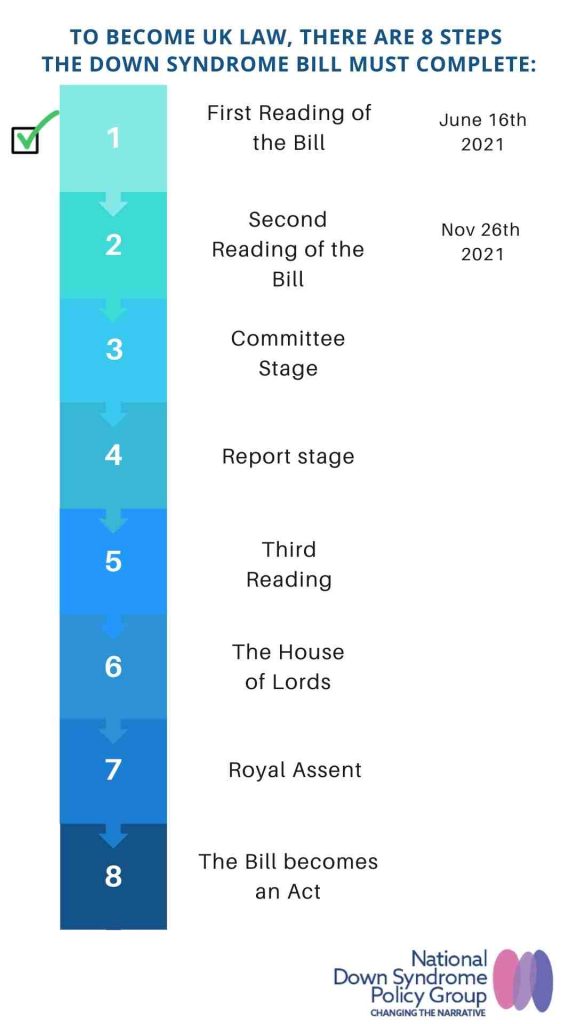
The NDSPG held an informative webinar to bring the community up to date that you can view here, be sure to follow them to be notified of further meetings.
A great gathering is planned on the 26th November outside Parliament and you are invited to join the party! To learn more see the event page and let us know you can come.

Social Cognitive Strengths and Difficulties in Down’s Syndrome
Lauren Jenner, who is a PHD student at the University of Surrey, is looking for children and young people who have Down’s syndrome (ages 4 to 17 years) ( both with and without a diagnosis of Autism Spectrum Condition (ASC) ) to take part in a study. Our chair, Dr Corcoran, had an informal chat with her about the project and why parents might like to be involved that you can watch here.
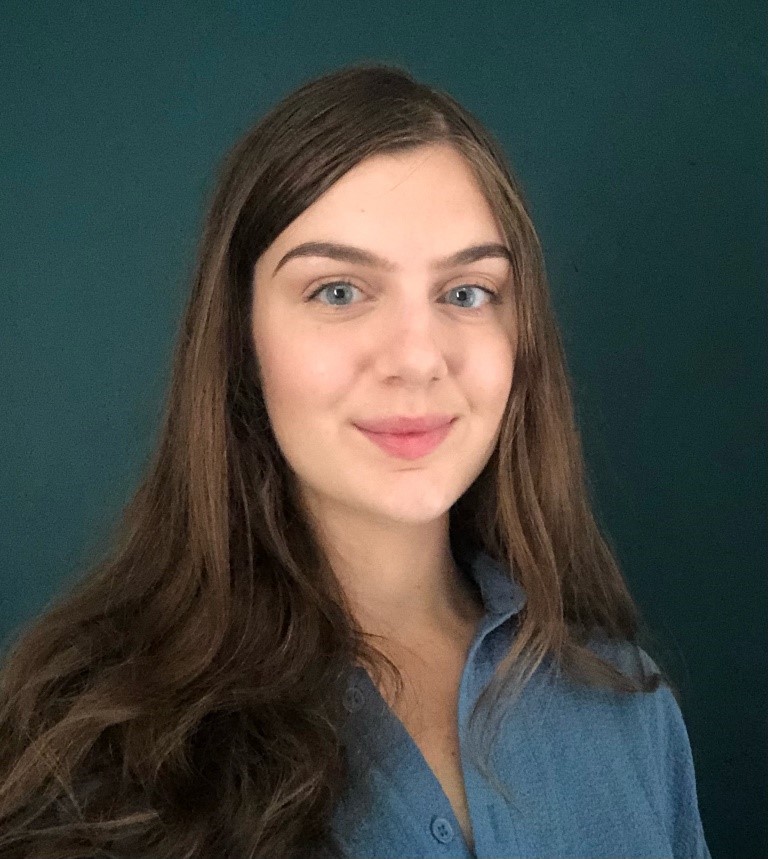
Lauren is researching how children and young people who have genetic syndromes process and understand social information. She aims to identify whether there are social processing differences characteristic of specific syndromes, and how these may relate to the presentation of autism traits.
People who have Down’s syndrome who take part in Lauren’s study will be asked to undertake:
- Some tasks and activities that demonstrate their social skills, verbal, and non-verbal abilities.
- Eye-tracking assessments which show the research team where a person is looking on a screen, giving them information about what that person finds interesting.
Parents will be asked to fill out some questionnaires and complete an interview over the phone.
Testing will be carried out remotely wherever possible. Remote testing sessions can be broken down into a number of short test sessions with rest breaks where needed. Overall, the whole study will take approximately 2-3 hours to complete. The research team will try and complete any face-to-face testing within one visit.
There is further information about the study here:
If you would like to take part in this study, have any questions or would like to discuss the study in more detail, please do not hesitate to contact Lauren using: l.jenner@surrey.ac.uk
BACKGROUND
Lauren and her colleagues are interested in how people who have Down’s syndrome process and understand social information such as faces, eyes and emotions. They would also like to know how social information processing relates to observable social behaviour skills that are central to navigating day to day interactions in people who have Down’s syndrome.
Since some people who have Down’s syndrome also meet the criteria for a diagnosis of ASC, Lauren is interested in whether individuals who have Down’s syndrome with and without ASC process social information in a way that is similar to or different from people who have ASC without a genetic syndrome. Lauren and colleagues hope that this work will lead to improved understanding of the social-cognitive strengths and challenges that are characteristic of individuals who have Down’s syndrome, those with other genetic syndromes associated with intellectual disability and people who have ASC with and without a genetic syndrome.
We asked Lauren how she believes her study may benefit people who have Down’s syndrome and their families:
‘Generating causal models that explain pathways contributing to variable risk for autism and phenotypic heterogeneity among individuals with Down syndrome will support greater precision in assessment and intervention that is informed by syndrome specific profiles.
‘Employing measures of social cognition which are accessible for those with intellectual impairment and/or limited language will support inclusion of individuals with Down syndrome in social cognitive research – addressing a current gap in the literature. Together, this research will advance understanding of autism in Down syndrome and help mitigate gaps in clinical services (Reilly et al., 2015, Thurm et al., 2019). Additionally, parents/caregivers can receive a personalised feedback report and/or a summary of the key findings from the study, which may be used to support their child (e.g., when seeking an autism assessment and diagnosis). There will be a clear statement at the top of each personalised feedback report highlighting the report is not a clinical report but results of a research study. Parents/caregivers are always advised to contact their GP or other appropriate professional if they wish to have clinical input.
‘In short, this work is imperative for understanding how individuals with Down syndrome process social information and whether this is related to the presentation of autism. It also will advance measurement of social cognition in this population. The ultimate key beneficiaries of the project will be individuals with Down syndrome, their families, and researchers investigating neurodevelopmental conditions.’
OTHER MEMBERS OF THE RESEARCH TEAM
 |
 |
| Dr Jo Moss is a researcher and lecturer at the University of Surrey. Through her research, Jo aims to further understand social, emotional and cognitive diversity in individuals with genetic syndromes. | Profesor Farran is a psychologist with expertise in children’s spatial abilities and how this relates to mathematics and science competence, and in understanding spatial learning difficulties in individuals with neurodevelopmental disorders. |
Dr Liam Fox MP introduces Down Syndrome Bill to Improve Life Outcomes
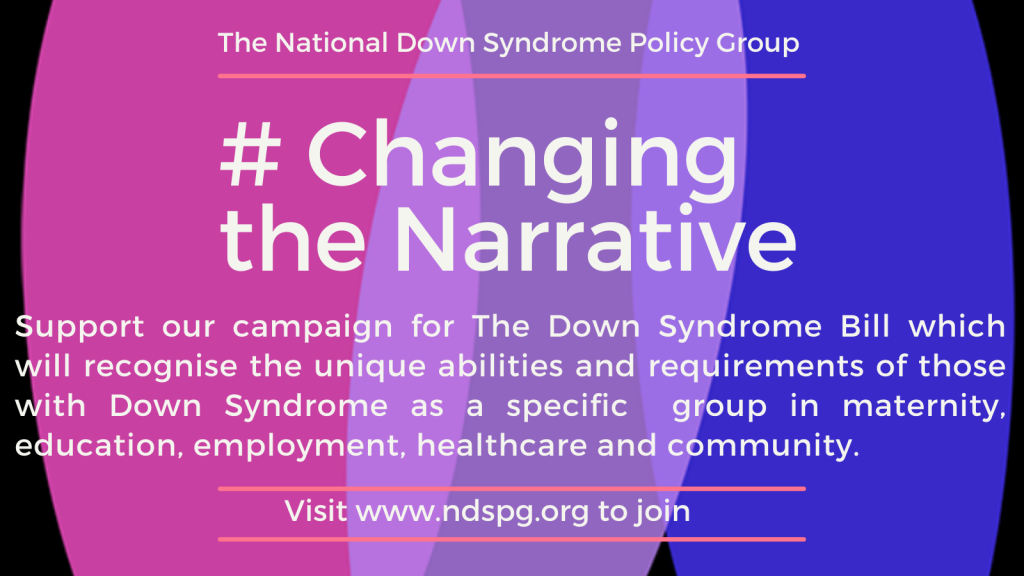
A Down Syndrome Bill is to be introduced to Westminster by Dr Liam Fox MP in the next Parliamentary session later this year. If successful, it will lead to the establishment of a Down Syndrome Act and a national strategy to improve provision and outcomes for all those living with Down syndrome in the UK. The Autism Act which became law in 2009 preceded the establishment of the national strategy to help meet the needs of adults with autistic spectrum conditions in England. The Down Syndrome Act will go further, identifying needs in all areas, for all individuals with Down syndrome across the whole of the UK. This will encompass, amongst other areas, maternity care, education, health, social care and employment.
The National Down Syndrome Policy Group, in coalition with the All-Party Parliamentary Group for Down Syndrome, has been lobbying for the long overdue Down Syndrome Act and have released a film featuring Founding Officers who have Down syndrome, highlighting some of the areas where they hope to see positive change in the future. Launch of The Down Syndrome Bill – YouTube
Dr Liam Fox MP, the Down Syndrome Bill Sponsor said,
“I am thrilled to bring forward a Bill to deal with the issues faced by those with Down syndrome. The full title is ‘A Bill to make provision about meeting the needs of persons with Down syndrome; to place a duty on local authorities to assess the likely social care needs of persons with Down syndrome and plan provision accordingly; and for connected purposes’.”
“My aim is to deal with three main areas. The first is to de-stigmatise Down syndrome and to re-educate both the public and professionals about the advances, including in life expectancy, that have occurred in recent decades. The second is to ensure that current provision of services is improved, whether provided by health, education or local services, by ensuring that providers give due consideration to those with Down syndrome when designing service provision. The third is to look ahead and deal with future issues, such as long-term care, in an era where, for the first time, many of those with Down syndrome will outlive their parents. By giving due thought to the issues today we can prevent avoidable human tragedies in the future.”
Actor and Founding Officer for the National Down Syndrome Policy Group (NDSPG) George Webster said:
“A Down Syndrome Act. Why didn’t we think of this before?!”
“We are all very excited that Dr Liam Fox is sponsoring a Bill with the aim of improving the lives of people living with Down syndrome.”
“I would like to see the Bill becoming law, then I think everyone like me with Down Syndrome will get better healthcare, more access to services and be more included in society. It is possible. It happens for some now, but it shouldn’t be a lottery. “
Peter Brackett, Chair of the NDSPG said:
“For too long the voice of the Down syndrome community has not been heard. We are delighted that the Down Syndrome Bill will enable engagement to secure and safeguard the rights and ambitions of the community across all aspects of society.”
“Having lobbied hard for this opportunity, our group will be fully behind Dr Liam Fox and the Down Syndrome Bill on its journey through Parliament, in line with our aim of raising the profile of issues affecting people with Down syndrome, their families and carers.”
Ends
- For more information, see the National Down Syndrome Policy Group website www.dspg.uk or email info@dspg.uk
- For media interviews with Dr Fox please contact David Goss David.goss@parliament.uk
- For interviews contact:-
-Ken & Rachael Ross MBE on 0771 0612 807 kenross@portsmouthdsa.org
-Lynn Murray on 0784 0966 736 or email lynn.murray@dspg.uk
-Peter Brackett on 0751 5121 733 peter.brackett@dspg.uk
- People with Down syndrome who are Founding Officers of the Down Syndrome Policy Group welcome the introduction of the Down Syndrome Bill: Launch of The Down Syndrome Bill – YouTube
- Line of Duty Star welcomes the launch of new APPG for Down syndrome https://www.heraldscotland.com/news/19295396.line-duty-star-tommy-jessop-backs-new-syndrome-all-party-parliamentary-group/
Line of Duty star with Down syndrome backs launch of new Down syndrome All-Party Parliamentary Group at Westminster
BBC’s Line of Duty star Tommy Jessop is backing the launch of the new All-Party Parliamentary Group (APPG) on Down Syndrome, which will be launched at an inaugural meeting at Westminster Wednesday 12th May 2021.

Actor Tommy Jessop, star of Line of Duty
A number of Down syndrome advocacy and support groups along with a cross-party group of MPs, led by SNP MP Dr Lisa Cameron and Labour MP Matt Western, have come together to launch the new All-Party Parliamentary Group on Down Syndrome.
The new group has been launched to raise issues affecting people with Down syndrome and their families and carers, as well as to promote equality and respect at all stages of life, to campaign for equal access and support in all areas of life and to highlight the innate worth of people with Down syndrome and the contribution they make.
The first meeting will include a speech by advocates with Down syndrome welcoming the establishment of the group and highlighting the issues that the group will be seeking positive change on. These issues range from maternity care for parents expecting a baby with Down syndrome to the matter of premature death for people living with Down syndrome.

APPG members will be supported by the newly-formed Down Syndrome Policy Group in the Secretariat role. The policy group is comprised of interest groups and individuals who have Down syndrome, therefore linking the parliamentary group to others with knowledge of the issues important to the wider Down syndrome community.
Line of Duty actor Tommy Jessop said:
“I welcome the new All-Party Parliamentary Group for Down Syndrome. I hope this will raise awareness of people living with Down syndrome and who we really are so that we really do have a voice to speak up for ourselves and other people”.
“I want to see people with Down syndrome treated equally with others before and after they are born. We are the only group of people in the UK where people try to end our lives before we are born just because we have Down syndrome. This is not fair. It scars our lives and causes mental health problems”.
Self-advocate Heidi Crowter, from Coventry, said:
“We hope that the members of the All-Party Group can use their powers and their energy to help make positive change for people like me and my husband James who has Down syndrome”.

Activist and Trustee of DSPG, Heidi Crowter
Conservative MP Elliot Coburn, the group co-chair, said:
“I was delighted to be asked to join the new All-Party Parliamentary Group on Down Syndrome, and to become a Vice Chair. People with Down Syndrome deserve a strong voice in Parliament to stand up for them and their families, and to press for greater support to help with the child’s development and for the family”.

Government Minister Caroline Dinenage said:
“I’m so delighted to support the All-Party Parliamentary Group for Down Syndrome. Portsmouth DSA is such a source of support, strength and positivity for so many individuals and families across our region. I am all in favour of action to ensure people with Down syndrome lead healthy, active and independent lives – that their talents are recognised and their voices heard”.
Warwick and Leamington MP Matt Western said: “The launch of this APPG is a chance for those in public life to celebrate the contribution of those with Down syndrome to their local communities, to the lives of their families and to British society in its entirety.
“It is vital we as politicians listen to those with Down syndrome so we can ensure that, through our work in Parliament, nothing holds people back from fulfilling their potential. I am proud to be part of this new APPG and I pledge to give those with Down syndrome a voice in politics whenever I can.”
Nicola Enoch from the Down Syndrome Policy Group said:
“We are striving to ensure that people with Down syndrome will have the opportunity to have their voices heard at Parliament. For too long their views have not been canvassed or heard; the APPG will provide a public platform for people with Down syndrome to speak”.

ENDS
-
For more information, see the Down Syndrome Policy Group website www.dspg.uk or email info@dspg.uk
-
For interviews, contact Lynn Murray on 0784 0966 736 or email info@dspg.uk
-
People with Down syndrome who are trustees of the Down Syndrome Policy Group introduce themselves: https://www.youtube.com/watch?
v=-zL0naw24a0&ab_channel= DownSyndromePolicyGroup -
Sharing the News Report 2019 – The maternity experience of parents of a baby with Down syndrome https://downsyndromeuk.co.uk/
flipbook.html -
Birth incidence, deaths and hospitalisations of children and young people with Down syndrome https://bmjopen.bmj.com/
content/10/4/e033770 -
Life expectancy and causes of death of people living with Down syndrome http://www.sldo.ac.uk/our-
research/life-expectancy-and- mortality/life-expectancy-and- causes-of-death-of-people- with-down-syndrome/ -
Down syndrome abortion figures are expected to increase as NIPT is rolled out across NHS hospitals. The number of babies born with Down’s syndrome has dropped by 30% in NHS hospitals that have introduced the new test. https://www.thetimes.co.uk/
article/new-test-brings-big- fall-in-birth-downs-babies- c89krkjcx