
Results of our Down’s syndrome and Covid-19 Survey-Part 1
Last month the Foundation and Positive About Down Syndrome jointly released a survey for all individuals with Down’s syndrome in the UK, asking about their health and issues relating to the Covid-19 pandemic. We are overwhelmed to report we had 901 responses from you all. Thank you! We have collected a wealth of information that we feel strongly belongs to you, the community. We will not use the data for our own benefit but ask you to consider donating to support this work, if you can.
“this data belongs to you, the community”

Our volunteers are processing the data and as we have worked through each section we will release a series of blogs discussing the results i.e. the health of school aged children, levels of co-morbidities (other diagnoses) there are and the impact on health as well as the impact on those with autism & ADHD, thyroid issues and other topics that emerge from the data.
In this post we will give an overview of who completed the survey and focus on the Covid-19 cases and the rates of general illness in the children & adults over the time period of the survey (Jan-April). We will focus on the health of school age children in the next post as we are mindful that schools are progressing towards reopening.
Who completed the survey?
In total 901 people (adults and children) are represented in the survey. The breakdown is:
Female 48.66% (437)
Male 51.34%. (461)
Ages:
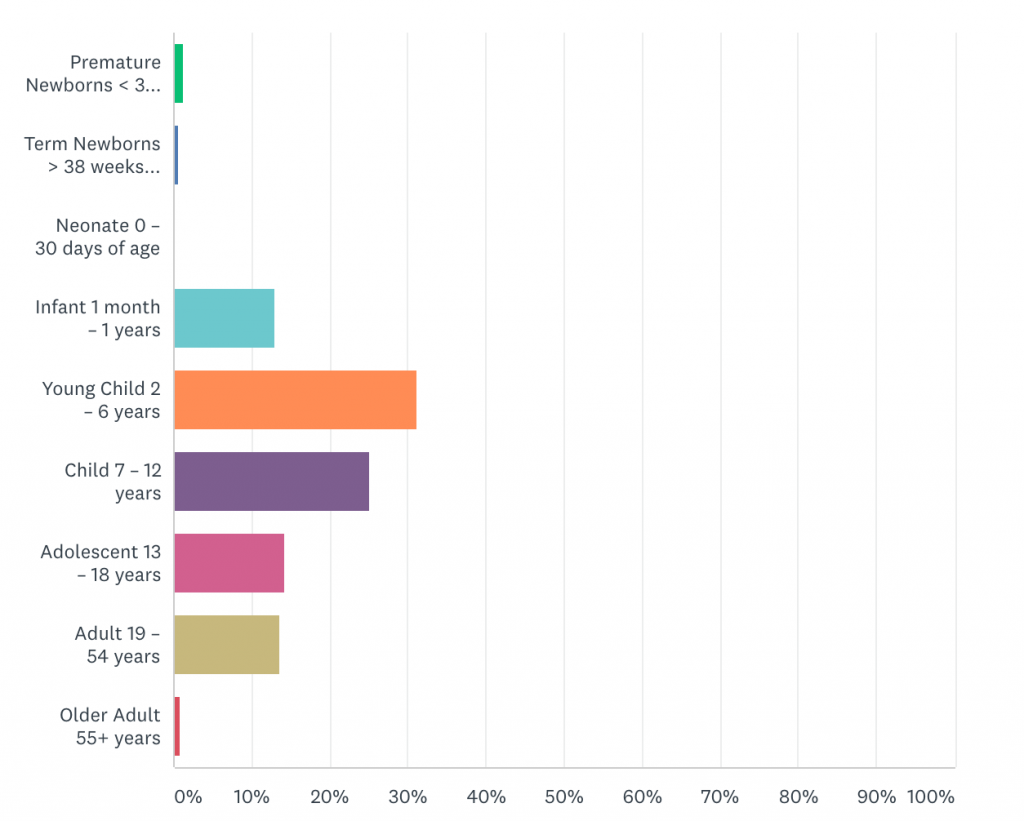
How old is your child/adult with DS? Answered: 898
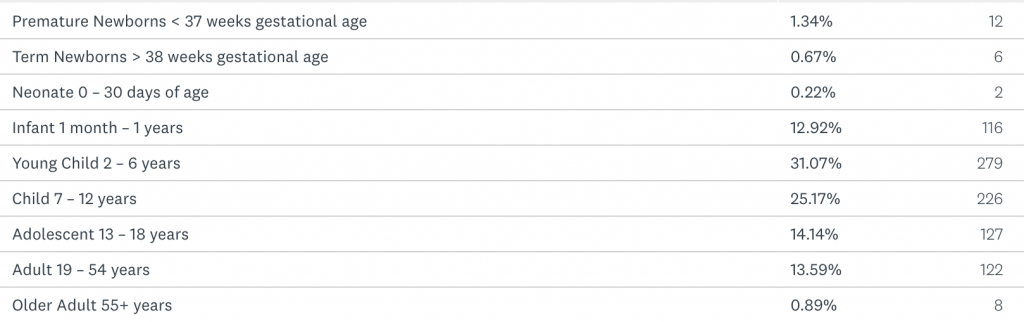
The Missing Groups
It is vital to note that as predicted getting sufficient adults in the survey proved very difficult- and those in care homes- nearly impossible. So the survey will tell us more about the health of children. Where possible we will try to compare within the age group as much as possible i.e. how many ill among one age range.
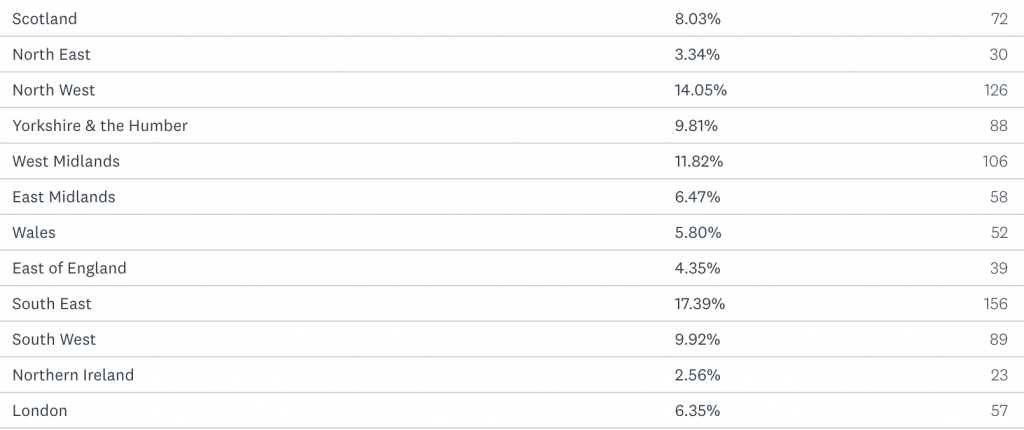
Regions:
Rates of illness over the 4 month period (Jan-Apr 2020) – 1st 1/3 of the year
Whilst reading this please keep in mind we are limited by the lack of testing as much as the rest of the UK population. We can draw a few conclusions but must not assume for example all ‘illness’ = ‘Covid-19’
We asked you to tell us about the worst illness over this period, which obviously for some of you meant you had to choose from more than one episode so the data won’t tell us how many times the person got ill. Also remember ‘ill’ is anything from sniffles to pneumonia needing admission.
Q How many didn’t get ill at all?
A Over half of people surveyed have not been ill during this time period (61%). Those that did not get ill 74% did have pre-existing conditions (including 10% with lung damage).
Q How many got ill in that 4 months?
A Under half surveyed did have some episode of illness (39%)
Let’s talk about the people who got ill. What do we know about them? We can see comparing within their age ranges that mainly infants and older adults had a bigger chance of reporting illness. ie. for the Infants 50 of 116 of them reported illness- 43%
|
Premature Newborns < 37 weeks gestational age–
|
5/12 41.6%
|
|
Term Newborns > 38 weeks gestational age
|
3/6 50%
|
|
Neonate 0 – 30 days of age
|
0/2 0%
|
|
Infant 1 month – 1 years
|
50/116 43.1%
|
|
Young Child 2 – 6 years
|
99/279 35.5%
|
|
Child 7 – 12 years
|
83/226 36.7%
|
|
Adolescent 13 – 18 years
|
43/127 33.9%
|
|
Adult 19 – 54 years
|
32/122 26%
|
|
Older Adult 55+ years
|
4/8 50%
|
| TOTAL | 319/898 |
In future posts we will analyse the rates of pre-existing conditions in those who got ill and the types of conditions our community have most and least. The results may surprise you.
How many had ‘Covid-19 symptoms’?
240 people reported symptoms that fit the ‘case definition‘ which is used to guide the doctor’s suspicion of Covid-19. But 50% of them required no medical assistance at all and managed at home (including not calling NHS111). 15% of this group were admitted (including the 8 with Covid-19). Eleven others in this group had negative Covid-19 tests.
Covid-19
We’d like to take this opportunity to remind you if your loved one experiences Covid-19 the T21 Research Society are still collecting data on cases of confirmed Covid-19 around the world, you can learn more here.
We are pleased to report on the outset that thankfully only 8 people reported confirmed Covid-19. Again remember that the government has not been aggressively testing so the low numbers you reported mainly indicate some of you required attendance at hospital and therefore testing.
The affected age ranges included 4 adults, 1 newborn, 1 infant and 2 aged 2-12 years. Most had at least 1 pre-existing condition, obesity and thyroid being most common.
Seven were admitted and 4 went to a general ward and 3 needed more support like oxygen treatments so went to ITU/HDU.
With such low numbers we cannot draw conclusions and will await the results of T21 RS survey as well. Please continue to bear in mind that at the very minimum those with DS fall in the ‘moderate increased risk group’ according to NHS guidance.
Official Shielding Letter
142 (15%) people received the letter from the government telling them to shield their loved one. Shielding letters have gone out automatically but not ‘perfectly’ including some not qualifying and leaving out others who should have one. To learn more visit the NHS guidance here. As stated above at the very minimum those with DS fall in the ‘moderate increased risk group’ according to NHS guidance i.e. learning disability and qualify for flu vaccines.
We will be back with more information about our school aged children as soon as possible but thank you again for taking part in this survey. For those of you new to our page we are the UK’s only Down’s syndrome research charity established over 20 years ago.
People affected by Down’s syndrome deserve the same research innovations to improve their health that other conditions have. Yet the annual research spending per person with Down’s syndrome to improve quality of life is currently in the region of £16.52, of which only £5.33 is towards treatment studies to test interventions.
We will bring the best scientific research to the issues affecting our community by:
- Funding and promoting ground-breaking medical research;
- Improving understanding of Down’s syndrome;
- Supporting the human rights of people with Down’s syndrome and their families through advocacy.
Our vision is a long, healthy, happy life for people with Down’s syndrome and their families. Please consider supporting our work.
DSRF was pleased to collaborate with Positive About Down Syndrome on this project to maximise reach and raise awareness of the Foundation.
Systematic review of research into Sleep Apnea Treatments in Children with Down’s syndrome
The Foundation is currently funding a Systematic Review of Research into Sleep Apnea Treatments in children with Down’s syndrome.
This piece of work forms part of ongoing research led by Dr. Cathy Hill and her team at the University Hospital Southampton. Our funding of the Systematic Review will allow Dr. Hill and her team to make further improvements. A Systematic Review of Research is a ‘deep dive’ into all published and unpublished research looking to answer a specific question. The scope of the search has been obstructive sleep apnoea treatments in children with Down syndrome, how best to diagnose it and what impact it has on children’s sleep and developing brains. Dr Rina Cianfaglione, research fellow to Dr Hill, will scrutinise the papers and systematically review the research that we have to date on OSA treatments in children with DS.
Why is it important to detect and treat Obstructive Sleep Apnea?
The detection and treatment OSA is vital because left untreated causes daytime behavioural problems, impaired learning and school performance, high blood pressure, reduced quality of life and increases health care use. Symptoms, such as snoring, gasping and restless sleep, and doctor’s examination are unreliable predictors of OSA, so objective screening is needed.
Currently children are not routinely screened and OSA is a low priority for many doctors. We at the Foundation however have grave concerns that the lack of detection and treatment protocols are causing multiple issues and reduction in quality of life for thousands in our community.
What does obstructive sleep apnoea look like?

Obstructive sleep apnoea (OSA) affects the throat (between the mouth and the voicebox) which is an important passageway for food to get to the stomach, but also air to the lungs. Because this tube is floppy it can block when children sleep, as their muscles relax. Children with Down syndrome have naturally lower muscle tone and a narrower airway, which is why they are more likely to have sleep apnea. When children snore, gasp for air and struggle to breathe in their sleep, this suggests the tube may be blocked. This is called ‘obstructive sleep apnea.’ It can happen throughout the night or only at certain times during the night. Often this causes children to wake up, but others simply become restless and toss and turn. Many children with this problem will sleep in unusual positions as they try to make more space in their airway to breathe, for example, sleeping with their head tipped back or sleeping sitting up. Either way, their sleep is disturbed and this can make them cranky or sleepy in the day- but not always!
- OSA is one of the most common comorbidities in people with DS.
- Obstructive sleep apnoea (OSA) affects up to 75% of children Down’s syndrome (DS) compared to 1-3% of typically developing children.
- OSA occurs when the back of the throat repeatedly collapses during sleep, blocking the airway and leading to repeated dips in blood oxygen and broken sleep.
- Vulnerability to OSA occurs throughout life in DS.
- In adults it increases risk of stroke and dementia.
- It is possible that OSA may contribute to the high prevalence of Alzheimer’s disease in adults with DS.
What is being done about it?
Parents frequently miss OSA or think the symptoms are ‘normal for Down’s syndrome’. Medical examination in the day may be normal offering false reassurance. UK national guidelines for OSA screening are rarely followed. Detection is crucial and research has demonstrated that initial screening with a simple tool (home pulse oximetry) sensitively detects OSA. This saves around half of all children needing detailed sleep studies in hospital. This urgently needs ‘real world’ evaluation to assess practical aspects of implementation before adoption within national medical screening guidelines for Down’s syndrome.
What are the current treatments for obstructive apnoea?
The standard treatment for childhood OSA is adenotonsillectomy (AT) but children with DS have higher risk of post-operative bleeding and admissions are most costly than for typically developing children. Furthermore, outcomes are not good. AT fails to eradicate OSA in 79% of children. This is not surprising as OSA in children with DS is also caused by low tone in the airway, overweight and structural differences in the face and tongue. An alternative approach is continuous positive airways pressure therapy (CPAP). This delivers a flow of air under pressure through a face mask, keeping the airway open at night. Reports from the UK and Australia suggest CPAP adherence and success in around 50% of children with DS. This is not perfect but is better than 21% success with AT and has fewer risks. CPAP needs to be assessed in a randomised controlled trial (RCT) and the Systematic Review will support further grant applications.

David testing his CPAP mask at his sleep study…two thumbs up!
In other news… How’s your Christmas shopping going? Can you help research at the same time?
Did you know that you can show your support through Amazon Smile by clicking below before you do your shopping and .5 % goes to support our work helping those living with DS at no cost to you?
All you need to do is select us as your chosen charity.
And every time you shop use – https://smile.amazon.co.uk/ rather than the plain amazon site and you’ll be showing your love for quality research!