
Adaptability of sleep and the ‘sleep privilege’: the need for new research
How much should parents and caregivers worry about sub-optimal sleep? This issue was recently brought to our attention by Professor Alice M Gregory, a keynote speaker at the recently launched Down Syndrome and Sleep Research Network (DSSRN).
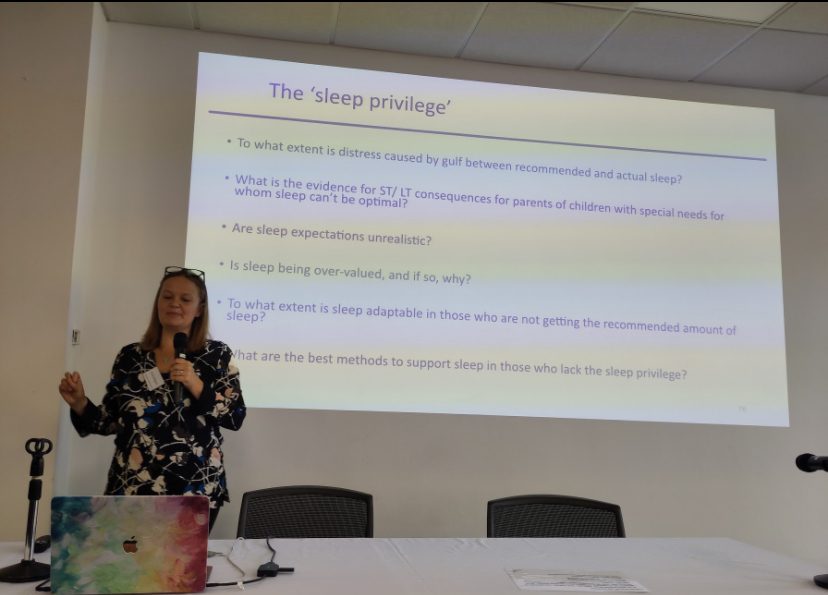
Sleep issues are over-represented and under-researched in the Down syndrome community. This gap is a driving motive for the DSSRN, and through this new research network, we hope to accelerate knowledge and effective interventions in this area.
The effect of broken sleep often weighs on parents and carers. This includes the health impact of poor sleep on family members with Down syndrome, but also the consequences of long-term interrupted sleep on caregivers themselves.
Prof Gregory has been involved in research with particular interest for caregivers. Her presentation at the DSSRN launch, “Type 1 diabetes as a prototypical condition challenging what we know about sleep”, opened up very interesting considerations about the pitfalls of an exaggerated focus and concern about quantifying and qualifying sleep.
Sleep is certainly more important for health and development than we have realised historically, but there are adaptive patterns that are even less understood, which may help compensate for some quantifiable sleep deficits.
This ability to adapt is also an under-researched area. Exploring this further will bring solid evidence that can help shape practice and guidance. This may be very good news for many people who simply cannot secure the ‘sleep privileges’ that others enjoy, and may ease some of the worries that come along with poor sleep.
We believe that this topic is just one of many areas that will benefit from the support of the DSSRN, bringing researchers together to change what we know about sleep in the DS community.
For further details on this topic, you can read a newly published editorial in the Journal for Child Psychology and Psychiatry, by Professor Alice Gregory et al, “Sleep privilege – research and clinical recommendations for when sleep cannot be optimal”.
World’s first research network focused on sleep issues and Down syndrome launched
Researchers from institutions across the UK gathered in London to foster cooperation in tackling sleep disorders that can profoundly affect health and development in the Down syndrome community.
The Down Syndrome and Sleep Research Network (DSSRN) was officially launched on Monday at the conference hall of the National Council for Voluntary Organisations, as an initiative to bring scientists together to concentrate on one of the highest priorities and most promising focal points for improving quality of life for people with Trisomy 21.
Sleep issues are common in people with DS, being detected up to ten times more than in typically developing peers. Researchers are keen to explore how improvements in sleep could positively impact development, cognition, chronic illnesses, and also longevity in a population whose life expectancy is at least 20 years lower than average.
Presenters included academics and researchers from University of Cambridge, Kingston University, Royal Holloway, Great Ormond Street and other institutions, presenting on their individual work and setbacks they have faced as researchers. A panel discussion with five interdisciplinary researchers generated a lively conversation on the challenges and opportunities in this area.
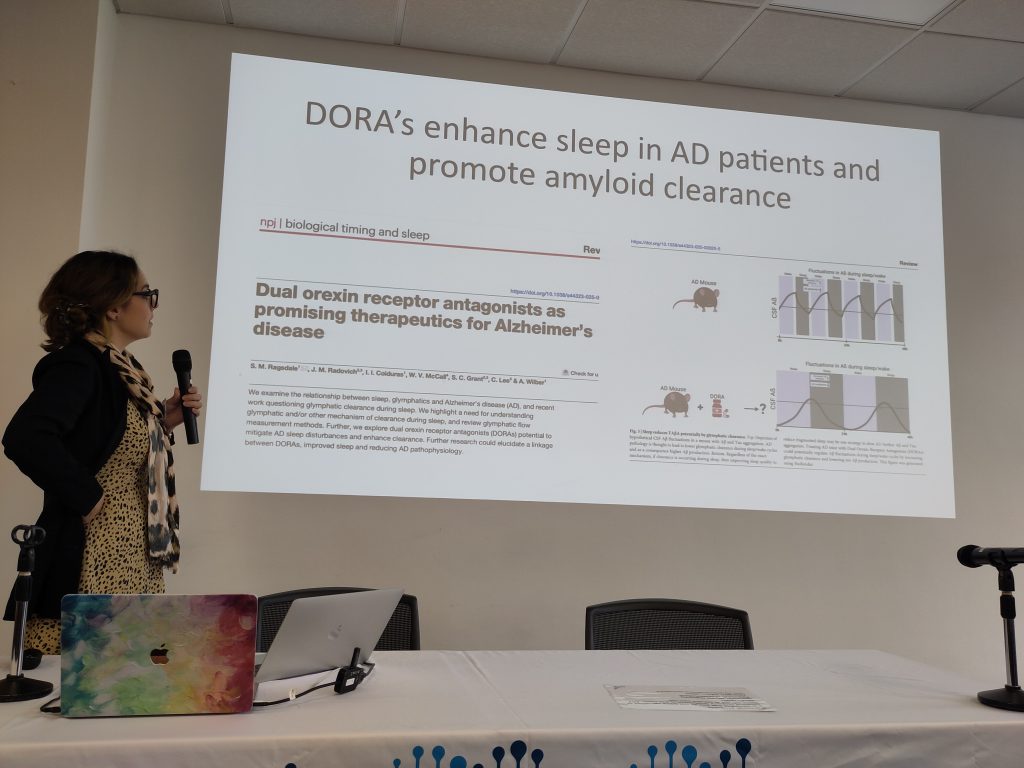
The role of sleep dysfunction in Down syndrome Alzheimer’s disease: Novel applied methodologies Dr Stephanie S. G. Brown Ph.D. – Senior Research Associate and Alzheimer’s Research UK Fellow, Department of Psychiatry, University of Cambridge
Keynote speaker Dr Lizzie Hill (Senior Lecturer in Sleep Physiology, University of the West of England (UWE Bristol) said “All of us in this room have heard something to the effect that ‘people with Down syndrome don’t sleep well’ or ‘it’s just part of the condition’, but that doesn’t mean we shouldn’t investigate and treat these as we would for anyone else.”
A poll of attendees on the day showed that 55% of attendees were currently involved in research, and 45% planning / would like to get involved, but experiencing barriers including lack of funding, lack of time and high workload, lack of research skills and knowledge, lack of support, bureaucracy and admin issues, ethics and regulatory processes, difficulty finding collaborators. Many of these issues were addressed on the day to explore ways forward.
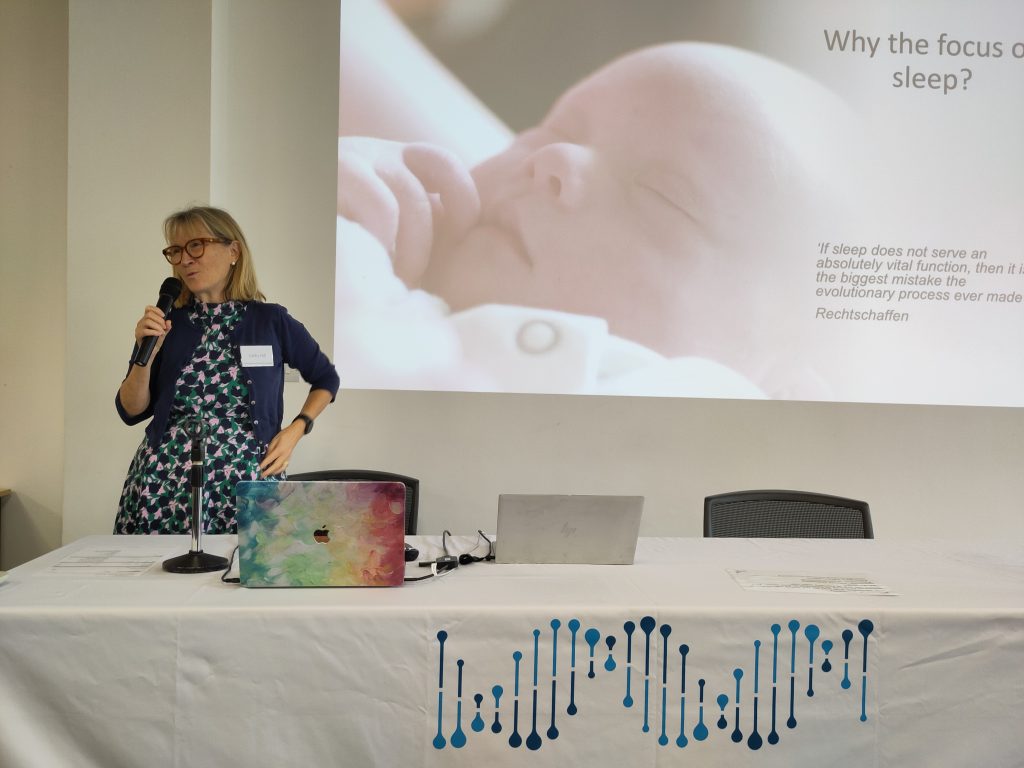
Prof Cathy Hill- BM MSc PhD FRCPCH – Professor of Paediatric Sleep Medicine – Southampton University
The DSSRN has secured funding for its startup year with generous grants from Hospital Saturday Fund, the Baily Thomas Charitable Trust, and the Sir Samuel Scott of Yews Trust, and the Launch Event was sponsored by Inspire Medical Systems and Idorsia. The DSSRN’s founding and launch have been coordinated by the Down Syndrome Research Foundation UK (DSRF UK), a charity promoting and funding medical research to improve the lives of people with Down syndrome since 1996.
DSRF UK’s Chair Dr. Elizabeth Corcoran said: “It has been a dream to bring these highly renowned researchers together to begin pooling their knowledge and expertise. We have great hope that with their combined insights, we’ll see breakthroughs in science in this area. This will yield new treatments that will give people with Down syndrome better sleep, from early childhood to adulthood, which will be a foundation for much healthier and longer lives.”
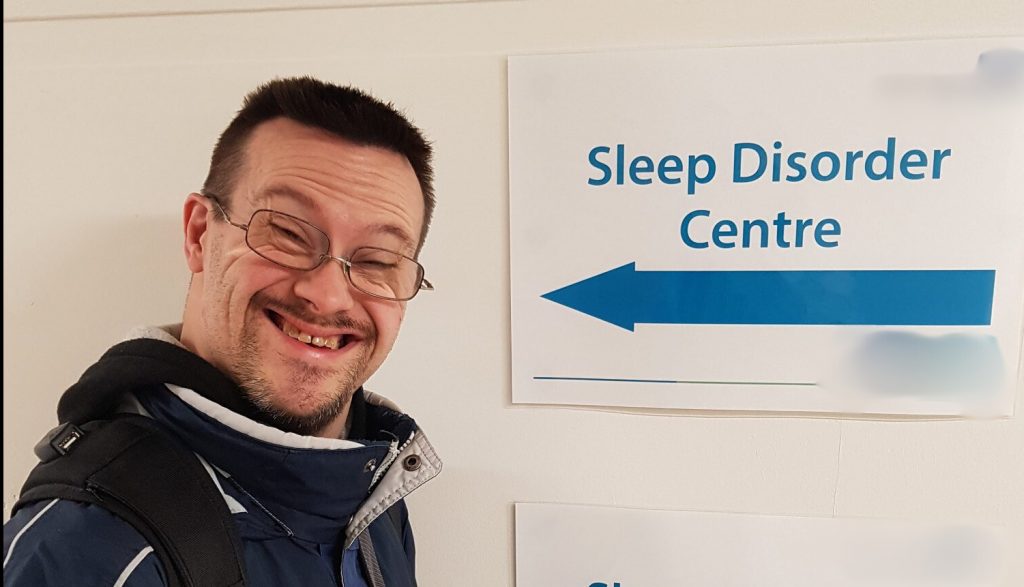
For more information, please see DSSRN’s website, and if you wish to stay in contact for updates, please fill out the form here: https://dssrn.org.uk/contact
Queries for the Down Syndrome and Sleep Research Network can be directed to: info@dssrn.org.uk
Launch Event for the Down Syndrome and Sleep Research Network:
now open for registration to professionals
We are reaching out to researchers, healthcare professionals, sleep charities and DS-focused charities to invite you to the launch of our new research network. The full-day event will be held in London on Monday 9th June 2025.
This launch event has now opened for sign-ups from professionals and charity representatives.
We are proud to announce that this research network will be the first of its kind globally, concentrating on the specific connections and challenges linking Trisomy 21 and sleep disorders, and we hope it will be at the forefront of breakthroughs in this field. If your work brings you in contact with sleep disturbances and their impact on the Down syndrome community, we would love to get connected to you through this event, and give you access to more information on what the Research Network will offer. The launch day will involve learning, networking, and focus on research and advancements in the area of Sleep Disorders and Down syndrome.
Sleep problems among people with Down syndrome are very common, and deficits in sleep create profound repercussions for health and longevity. This research area has long been identified as crucial to focus on: but until now, it has not been given the attention needed. We invite you to come and see how your expertise and skills may help contribute to new advances in sleep science specific to the DS community. We encourage you to spread the word about the launch to colleagues and friends in related disciplines, if you can. The event is free, thanks to generous sponsors.
The day begins with an introduction to DSSRN’s mission and goals, followed by expert-led presentations covering the latest research and clinical insights. Professor Catherine Hill and Dr Lizzie Hill will provide a comprehensive overview of sleep issues across paediatric and adult populations. Dr Stephanie Brown from the University of Cambridge will explore cutting-edge imaging research that examines the role of sleep dysfunction in Alzheimer’s disease among individuals with Down syndrome, alongside insights into behavioural complexity in related conditions like Prader-Willi syndrome.
Sessions will also include an early case report on Inspire device upper airway stimulation from the team at Great Ormond Street Hospital, presented by Mr Liam Sutton. Prof Alice Gregory will be discussing sleep disturbances in type 1 diabetes as a model for broader understanding.
Thanks for your support in making this launch a success and helping it reach as many interested professionals as possible. It’s time to cooperate to bring about change through sleep research for the worldwide Down syndrome community.
How to register to attend the launch: Please get in touch with organisers at info@dssrn.org.uk to claim tickets and for more details on the event.

David Elliott and Dr Liz Corcoran, chair of the DSRF UK and sister.
Recruiting Now- the Rest-Ed Study on sleep in children with DS
Many children with Down syndrome (DS) experience sleep problems that can affect both their health and the wellbeing of their families. These issues may be due to breathing difficulties during sleep (like sleep apnoea) or challenges with settling down and staying asleep.

The Rest-Ed Team are inviting families to participate in a new study aimed at improving sleep for children with DS, aged 6 months to 5 years. This research will help us find out if a simple parent education package—including an MP4 film, booklet, and brief talk – delivered online in a small group setting to parents/carers can improve sleep and quality of life for both children and their carers.
How the Study Works:
- Families will have a sleep study done at home.
- Children will be assigned to one of two groups to receive the parent education package.
- Parents will complete short questionnaires about sleep and quality of life throughout the study.
- All aspects of the study are performed online/remotely.
This research is being conducted by NHS Lothian and the University of Edinburgh, with support from Down’s Syndrome Scotland BUT they are now pleased to announce they are recruiting across the UK!
Want to Take Part? If your child is aged between 6 months and 5 years and has DS, you may be eligible to join.
To learn more, please contact the REST-Ed team at loth.rested@nhslothian.scot.nhs.uk
Speak to the lead investigator, Dr Florian Gahleitner on 0131 312 0453
Please share the poster to spread the word!

.
Calling for more evidence – Down Syndrome Act 2022
Thanks to widespread public and political support, we now have a Down Syndrome Act! Thankfully the Foundation and it’s trustees worked together with the National Down Syndrome Policy Group (NDSPG) to have a voice and be involved in the passing of the Act. We are here with an important update on where we are in the progress towards it’s implementation.
The Down Syndrome Act requires the Secretary of State to publish statutory guidance about the specific needs of people with Down syndrome which health, social care, education and other local authority services (such as housing) must take into account when commissioning or providing services. Once the guidance is published these authorities are legally required to take the guidance into account when providing certain core services.
The NDSPG we believe it is vital that those with Down syndrome, their families, carers, friends and experts working with them, contribute to the guidance in a meaningful way because they understand the frustrations and limitations of current systems and also have many views about how to improve things. They know what works and what doesn’t, what is helpful and what is a hindrance, what is beneficial and what is a waste of time.
But they need to hear from you!

We are pleased to announce the launch of the second phase in the NDSPG’s online consultation. In phase 2 they move into a more quantitative approach, asking specific questions.
They appreciate that not all of you will have experience across all of the topics, so they have created individual questionnaires split into three different respondent types:
To be completed by Parent / carer
- Education
- Transitioning into adult social care
- Social care for children / young people under 18
- Healthcare
To be completed by individual with Down syndrome, with assistance where necessary
To be completed by professionals who help people with Down syndrome
The NDSPG appreciate that some of you may feel daunted by the task of completing these surveys. An alternative might be to hold face to face meetings with your local group/peers to get feedback in person. Please get in touch if you would like to do this but need support in how to facilitate.

In addition to our consultation we recommend as many people complete the Government’s own Call for Evidence
Research Assistant Required
The NDSPG are also looking for postgraduate students to support as Research Assistants working on the analysis of qualitative data. Please email contact@ndspg.org to discuss terms. Please do share this great opportunity to work with a dynamic team as they analyse the data from our consultations and present to the Government as part of their call for evidence for the Down Syndrome Act.
New publication on needs of those with NDDs during the Pandemic
A new paper is released today in the British Journal of Psychiatry co-authored by the chair of the Foundation, psychiatrist Dr Corcoran, on the needs of individuals with neurodevelopment disorders (NDDs) and the Covid-19 pandemic. Dr Andre Strydom, psychiatrist and president of the Trisomy 21 Research Society, and Dr Anne-Sophie Rebillat, geriatrician with the Jérôme Lejeune Institute, worked together on the editorial about the issues that have faced our community since the pandemic began.
People with neurodevelopment disorders have been overlooked in many ways during the Covid-19 pandemic, for example gaps in understanding of risks, presentation of disease and outcomes. The Foundation was please to be able to contribute data around how many other conditions (co-morbidity) and medication adults and children in our community are on via our Covid-19 and Down Syndrome survey results.
The authors highlight the issues around the care and protection of those in care homes as a priority in pandemics as they frequently fall between the cracks of the health service and social care, leading to disastrous consequences. Issues around the clinical frailty scale and vulnerably are discussed.
Read the editorial here.
All Party Parliamentary Group (APPG) for Down syndrome
EXCITING ANNOUNCEMENT FOR OUR COMMUNITY
All Party Parliamentary Group (APPG) for Down syndrome being formed!
Over the past few years, a number of parent led organisations have been campaigning and lobbying in Parliament around issues, particularly in maternity care, that our community faces.
We discovered that there has not been an APPG for Down syndrome since 2015, so some of the groups have created an alliance to form an APPG. This will provide an opportunity for the views of people with Down syndrome and their families to be heard and addressed at Parliament. The APPG will give our community a platform to challenge some of the issues our families face and to raise awareness about living with Down syndrome in modern Britain.
An All Party Parliamentary Group (APPG) is a group of members from the House of Commons (Members of Parliament) and the House of Lords (Peers). It is all party because it has to have at least one member from the party in government (Conservative) and at least one from the main opposition party (Labour).
We have written to all Parliamentarians to invite them to join our APPG. It would be really powerful if as many people as possible could make contact with their local MP to request that they join our APPG on Down syndrome. Anybody who is allowed to vote can contact their MP and request they join – so we are asking people with Down syndrome to write and will be supplying an easy read version of this document together with a template. We hope that parents, siblings, grandparents, friends, professionals – anyone and everyone who is keen that the voices of people with Down syndrome are heard at Parliament will contact their MP.
We will be inviting people with Down syndrome to be involved with the APPG by participating in meetings and focus groups. If you have Down syndrome and are interested in being involved or have a family member with Down syndrome who is interested, please email dsappg@gmail.com
If you can add some of your own information in the first paragraph, it makes it more relevant and powerful. Please copy us into your email so we can record which MPs have been contacted. Email dsappg@gmail.com

APPG-For-Down-syndrome-easy-read
Dear (insert name of MP)
I am writing to you both as a member of your constituency and also proud parent/sibling/grandparent/teacher etc to (insert name) a (young person/child/adult) with Down syndrome. We would ask that you kindly consider joining the APPG for Down syndrome that is being formed to ensure the voices of those with Down syndrome including my (son/grandson/brother/student/friend etc) are heard at Parliament.
A coalition of national and regional groups have formed to act as the secretariat to the APPG.
The statement of purpose for the APPG is to campaign for equal access and provision to ensure equality and promote respect at all stages of life for people with Down syndrome.
Over recent years there have been huge advances in medical and educational development to enable people with Down syndrome to live full, rewarding and long lives, yet ironically whilst the future is looking so bright for our children and young people, outdated attitudes and legislation, discriminate against people with Down syndrome from the womb to the grave.
- In maternity services there is a blatant negative bias, with 69% of expectant women being offered a termination in the same conversation as being advised baby has Down syndrome.
- Termination to full term is permitted on the grounds of baby having Down syndrome. Women’s choices to continue are not supported with no care pathway and pressure to terminate – expectant women being told ‘it’s not too late’, at 36 weeks.
- In health care, the LeDeR report has cited that people with learning disabilities die on average 16 years younger than people without. It is estimated that 1,200 people with a learning disability die avoidably in the NHS each year.
- Employment opportunities are woefully inadequate, with only 6% of adults with a learning disability being in paid work.
- The annual research spending per person with Down syndrome to improve quality of life is currently in the region of £16.52, of which only £5.33 is towards treatment studies to test interventions.
People with Down syndrome deserve better and with your support we can ensure that their voices and views are represented to ensure equality for all.
I look forward to hearing favourably from you, should you require any further information please do not hesitate to contact me or the coalition by emailing dsappg@gmail.com
Yours sincerely
(insert your name)
Diagnostic Overshadowing
#HoldsMeBack
Today we’re going to talk about the effect of diagnostic overshadowing in one little girl’s life. But first, what is it? Diagnostic overshadowing is when ‘symptoms of physical ill health are mistakenly attributed to either a mental health/behavioural problem or as being inherent in the person’s learning disabilities’ (Emerson and Baines, 2010). It can cause anything from a slight delay in diagnosis to an increased risk of death because someone tells you, for example, ‘it is normal for down’s syndrome children to have low oxygen/not pass stool for days…’.

What factors affect the medical care of people with learning disabilities?
“…normal for down’s syndrome”
We feel that this phenomenon is a critical piece in the puzzle when we look at the reasons for the of lack research and the poorer health outcomes in our community[1]. Despite the certainty touted on the DS awareness memes this month, we can only draw one conclusion when we read each ‘fact’ : this is what we know now. Take for example the lifespan meme, why has that increased? Basic medical care, heart repair operations have been made available to those who need it. Here we are in 2020, much is still unknown about Down’s syndrome (and its associated conditions) and therefore the possible best supportive therapies. Has the book closed on Down’s syndrome, marking a ‘full stop’ on progress and advances to help our loved ones? No, not if we are looking, learning and investigating the possibilities through medical research.
Hazel’s story
Hazel is nine years old and has the biggest smile you could ever see. Often accompanied by the heartiest belly laugh imaginable. Where ever you are in the house, whatever you are doing, you stop and go see what’s made her laugh. Often you have no idea, but you join in anyway – it’s contagious. Hazel is a joy to be around!
Hazel also has Down’s syndrome. She has Autism. She also has a feeding tube. She’s still learning to walk and it’s hard for her. Oh, and she doesn’t talk; at least not with words.
When Hazel was born, I remember hoping and praying that she had the ‘not too bad’ version of the condition. The one that we often hear talked about in the DS community. The one that said she would walk, talk, go to mainstream school, get a job, get a flat, get married and live happily ever after – the “what’s so Down about that” kind of narrative. That version.
It’s that version – or rather the expectation that she should be that version that I think may have held Hazel back in some ways. It’s certainly held me as her parent back from helping her overcome her challenges. I’ve often been told by our own community and some in the medical profession who support us that ‘she’s just delayed’. She’ll get there. Concerns I’ve had about what appear to be more severe ‘delays’ in Hazel than in most children with Down’s syndrome have, at times, been minimised. I’ve been handed the overly anxious parent badge on more times than I care to remember. And, when that badge is given by a medical professional it’s often accompanied with a shrug of the shoulders or a sighed “Yes well that’s Down’s syndrome or that’s the Autism”. Conversation closed. No further explanation or exploration needed. See you in a years’ time.

Hazel at her riding class!
Hazel is the happiest nine-year-old I know. She accepts the world around her and the people in it as they are. She makes no demands on them other than to be loved. For me, loving Hazel means caring for her and being her voice. I need the help and determination of others to do this; to be willing to explore her life, her experience, her needs in depth. I need, she needs the medical profession to go the extra mile to find out how best to help her. She needs to be seen as Hazel, a person with Down’s syndrome but a person first. Yes, Down’s syndrome is in every cell, every fibre of her being, of Hazel. But it should not automatically disqualify her from the help she may need throughout her life. It should not be used as an end to a discussion on her needs but a beginning.
Why are her ankles so badly deformed; meaning that she will never be able to walk without orthotic support? Is it ‘because she has Down’s syndrome’ or, more recently, ‘because she has Autism’? And, if it is, then why is no one doing anything about trying to help find the causes of this and treat it at an earlier stage? The DS community is badly let down by Government on this as they continue to pass over them as being worthy of any kind of research into improving their lives. Or perhaps they are so deformed because we didn’t know there was a problem. We assumed she was just ‘delayed’ and had no idea that our attempts to help her to learn to walk were actually doing more harm than good. And, in what other aspects of her physical and emotional development, is more harm being unnecessarily done due to the fact we have labelled those areas ‘delayed’ without fully understanding why?
A delay has a cause that should always be investigated. When Hazel’s older sister experienced delays in learning to walk investigations were made immediately and regular treatment ensued. The delay was enough to warrant a concern. A question mark. A plan was put in place. She got the help she needed.
Yet with Hazel it seems as if having Down’s syndrome is a full stop. A reason to end the conversation and offer no further explanation. And, for too long, our community has been guilty, myself included, of accepting this.
In Hazel’s case diagnostic overshadowing is what #HoldsMeBack and that’s why I’m getting behind the DSRF’s campaign this month to raise awareness and challenge thinking in this area. It’s too critical to the well being of all people with Down’s syndrome to ignore.
“It’s too critical to the well being of all people with Down’s syndrome to ignore.”
Please consider supporting our work through a one-off or regular donation or by fundraising for us. We cannot wait, our community needs us.
Our deep thanks to Alison and Hazel Morley for sharing their story. You can follow them here.
To download a selfie poster:
(Previous Banner image credit: Young girl with Down’s syndrome. Credit: Fiona Yaron-Field. Attribution 4.0 International (CC BY 4.0)
1 Early death and causes of death of people with Down syndrome: A systematic review Lisa O’Leary et al. 2018 https://doi.org/10.1111/jar.12446
#HoldsMeBack
Down’s Syndrome Awareness Month

Welcome to the start of another Down’s Syndrome Awareness month, this year our focus as a charity is the theme #HoldsMeBack. This year we want to do something different and invite the community to challenge some of the ideas we’ve held as ‘gospel truths’ about Down’s Syndrome for many years. With the passage of time, and medical research and advances, ideas that became untruths or less certain.
When we look at this lovely young man we can imagine what his parents were told when he was born. Language and terminology that now is considered derogatory or even hate speech. Limitations and expectations were taken as facts. Perhaps they were told “he might not walk/talk/learn” or “you need not bring him home”. Indeed to take a child with Down’s Syndrome home was counter cultural for many years.
In the past no one questioned the information they were passed and, like batons, these ideas were passed on to others through the years. As society decided they deserved the same rights as others; access to education and healthcare was slowly drip fed to each passing generation of people with Down’s Syndrome. So we saw that when offered the same stimulating environments, educational adjustments and basic healthcare we saw our community- as a whole- move forward.
I do not believe that the majority of the ‘professionals’ of the past held ill will against our community, they just saw things a certain way. Questioning it would have seemed ludicrous, these were the ‘facts’ about Down’s Syndrome.
What about now, in 2020? What immutable ‘facts’ will we see passed like batons this year? We want to ask you to think about ‘Why?’ these ‘facts’ might be so. When our mother in the 1900s was told “he will never read” was that he couldn’t or because her beautiful son needed speech and language therapy, glasses and basic education? Let’s begin by unpacking why myths seem to predominate the community (hint: lack of research will feature!).
There are many myths and misconceptions about people with Down’s Syndrome which can be attributed to a couple of factors:
Firstly, society’s understanding of Down’s Syndrome has not yet caught up with the real life experience of living with the condition today. Whilst many people with Down’s syndrome are more visible in our communities, there remains a stubborn reluctance to equally celebrate the life of those with the condition. Even within the Down’s syndrome community myths are perpetuated rather than challenged. We are rightly encouraged to love and accept people with Down’s syndrome but not to question how the condition holds them back.
“Even within the Down’s syndrome community myths are perpetuated rather than challenged.”
This leads us to our second point, that the lack of specific medical research means we are unable to challenge our healthcare professionals to provide targeted care that understands the medical needs of those with Down’s syndrome.
Over the coming weeks, to celebrate Down’s Syndrome Awareness Month, the Foundation will challenge the myths that often circulate during awareness campaigns. We believe acceptance of these myths, particularly from within the community, hinders the demand for research into areas which would specifically benefit those with Down’s syndrome. There are many advances that we can celebrate together but we must not take our eye off the ball and allow the general health of those with Down’s syndrome to plateau. We owe that to those have come before us, the trail blazers.
“What holds you back?”
For this year’s Down’s Syndrome Awareness Month we will be asking people with Down’s syndrome, their loved ones and carers “What holds you back?” It is right we ask people how their lives can be made healthier or what issues make life hard. At the Foundation we want all people with Down’s syndrome to thrive but we cannot achieve this if we do not acknowledge the very real problems that do exist.

“…just £5.33 per person with Down’s syndrome is spent on research that could directly benefit them”
Currently just £5.33 per person with Down’s syndrome is spent on research that could directly benefit them through interventions (per year)1. This compares with £228 for those with cancer, and £127 for those with dementia. We are committed to funding research that will improve medical, cognitive and mental health issues associated with Down’s syndrome, we cannot stand still and we need your help- to fundraise, donate and spread the word.
Do please tell us “What holds you back” by downloading our HoldsMeBackPoster poster (condition specific posters also below). Please send us a photo of you holding the sign and we will include it in our research awareness posts on social media and our blog.

David Elliott and Dr Liz Corcoran, chair of the DSRF UK and sister.
Banner image:
New York State Institute: a group of boys with Down’s syndrome, standing on some steps. Shuttleworth, G. E. 1842-1928. Date 1902