
All Party Parliamentary Group (APPG) for Down syndrome
EXCITING ANNOUNCEMENT FOR OUR COMMUNITY
All Party Parliamentary Group (APPG) for Down syndrome being formed!
Over the past few years, a number of parent led organisations have been campaigning and lobbying in Parliament around issues, particularly in maternity care, that our community faces.
We discovered that there has not been an APPG for Down syndrome since 2015, so some of the groups have created an alliance to form an APPG. This will provide an opportunity for the views of people with Down syndrome and their families to be heard and addressed at Parliament. The APPG will give our community a platform to challenge some of the issues our families face and to raise awareness about living with Down syndrome in modern Britain.
An All Party Parliamentary Group (APPG) is a group of members from the House of Commons (Members of Parliament) and the House of Lords (Peers). It is all party because it has to have at least one member from the party in government (Conservative) and at least one from the main opposition party (Labour).
We have written to all Parliamentarians to invite them to join our APPG. It would be really powerful if as many people as possible could make contact with their local MP to request that they join our APPG on Down syndrome. Anybody who is allowed to vote can contact their MP and request they join – so we are asking people with Down syndrome to write and will be supplying an easy read version of this document together with a template. We hope that parents, siblings, grandparents, friends, professionals – anyone and everyone who is keen that the voices of people with Down syndrome are heard at Parliament will contact their MP.
We will be inviting people with Down syndrome to be involved with the APPG by participating in meetings and focus groups. If you have Down syndrome and are interested in being involved or have a family member with Down syndrome who is interested, please email dsappg@gmail.com
If you can add some of your own information in the first paragraph, it makes it more relevant and powerful. Please copy us into your email so we can record which MPs have been contacted. Email dsappg@gmail.com

APPG-For-Down-syndrome-easy-read
Dear (insert name of MP)
I am writing to you both as a member of your constituency and also proud parent/sibling/grandparent/teacher etc to (insert name) a (young person/child/adult) with Down syndrome. We would ask that you kindly consider joining the APPG for Down syndrome that is being formed to ensure the voices of those with Down syndrome including my (son/grandson/brother/student/friend etc) are heard at Parliament.
A coalition of national and regional groups have formed to act as the secretariat to the APPG.
The statement of purpose for the APPG is to campaign for equal access and provision to ensure equality and promote respect at all stages of life for people with Down syndrome.
Over recent years there have been huge advances in medical and educational development to enable people with Down syndrome to live full, rewarding and long lives, yet ironically whilst the future is looking so bright for our children and young people, outdated attitudes and legislation, discriminate against people with Down syndrome from the womb to the grave.
- In maternity services there is a blatant negative bias, with 69% of expectant women being offered a termination in the same conversation as being advised baby has Down syndrome.
- Termination to full term is permitted on the grounds of baby having Down syndrome. Women’s choices to continue are not supported with no care pathway and pressure to terminate – expectant women being told ‘it’s not too late’, at 36 weeks.
- In health care, the LeDeR report has cited that people with learning disabilities die on average 16 years younger than people without. It is estimated that 1,200 people with a learning disability die avoidably in the NHS each year.
- Employment opportunities are woefully inadequate, with only 6% of adults with a learning disability being in paid work.
- The annual research spending per person with Down syndrome to improve quality of life is currently in the region of £16.52, of which only £5.33 is towards treatment studies to test interventions.
People with Down syndrome deserve better and with your support we can ensure that their voices and views are represented to ensure equality for all.
I look forward to hearing favourably from you, should you require any further information please do not hesitate to contact me or the coalition by emailing dsappg@gmail.com
Yours sincerely
(insert your name)
Prenatal Care
#HoldsMeBack
“The only thing a prenatal diagnosis can provide is a first impression of who a child will be.”
A prenatal high chance or diagnosis of Down’s syndrome comes as just as big a shock to expectant parents as to parents who do not find out until birth. There are lots of conversations between parents as to which is the ‘easier’ way to find out.
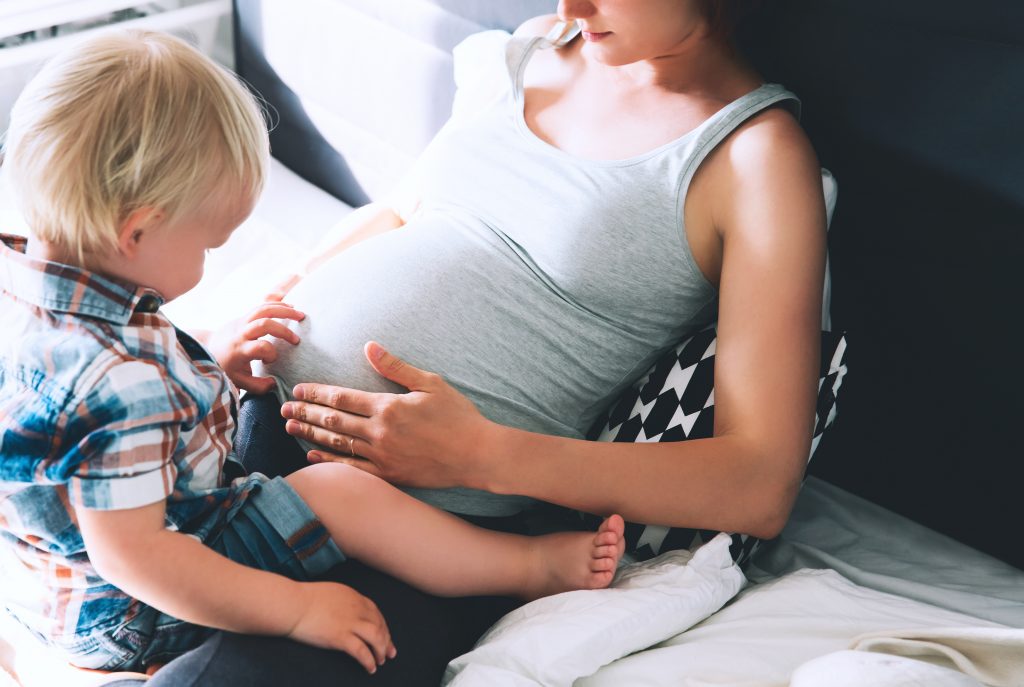
A prenatal diagnosis means parents have had some time to process the news but they have lived with the worry of a higher chance of miscarriage and stillbirth(1). They have been asked, often several times to make ‘a choice’ and most likely overcome some negative and misplaced comments from the medical professionals looking after them. They have worried about how their child will be affected, what their needs will be, they have had sometimes difficult conversations with partners and probably had a few extra scans looking for ‘problems’. It was not an easy route but when baby arrives it is a time for celebration as parents finally get to meet their little one who has taken them on a different path to the one they expected at the beginning (2).
A postnatal diagnosis comes as a shock too, the longed for arrival isn’t as expected and no one quite knows what to say or how to respond. The tears flow even as a mother embraces her newborn, this is not what she wished for. These parents haven’t had months to adjust but have to rapidly catch up whilst caring for their new baby supported by maternity staff who may not know what to say or do. The consolation is they probably had a less stressful pregnancy, blissfully unaware of the adjustment they will have to make (3).
You’d imagine that one of the clear advantages of ‘knowing’ beforehand is that the maternity unit would be well prepared to support expectant parents and their little ones. You would think there would be a well researched pathway that all medical professionals could follow, making sure that these little ones are given the very best chance of arriving safely. You’d think there would at least be some national guidelines that identify what sonographers and consultants should be looking out for and what actions they should take. The sad fact is miscarriage and stillbirth rates are higher if the baby has Down’s syndrome but the sadder fact is that with better care and more supervision some of these deaths could have been prevented. We know babies with Down’s syndrome have a habit of arriving before their due date, we know the placenta might not be working as efficiently as it should and yet there is no clear plan as to how to manage these pregnancies to an successful outcome.
It is true a prenatal diagnosis doesn’t tell us of the full and love filled life that a child may have, the baby with Down’s Syndrome will write their own story just like any other child. But a prenatal diagnosis can have many advantages where care of mother and baby is research based and takes account of the possible complications, monitors appropriately and manages potential issues quickly should they arise. Sadly the Royal College of Obsteotricians and Gyneacologists has still not provided such a pathway despite much pressure from the Foundation and Positive About Down Syndrome. However we are proud to be working in collaboration with forward thinking practitioners who recognise the dangerous inconsistency in managing pregnancies where baby has Down’s syndrome.
You are probably not aware that just £16 per person with Down’s syndrome is designated for research (compared to over £200 per person with cancer). Of that paltry figure, £11 is spent on screening (4). The obsession with screening means improving the chances of wanted babies arriving safely is under researched and under funded. Please support the Foundation as we gather and commission research that helps inform and guide our health professionals.
——————————–
1 Sparks TN, Griffin E, Page J, Pilliod R, Shaffer BL, Caughey AB. Down syndrome: perinatal mortality risks with each additional week of expectant management. Prenat Diagn. 2016 Apr;36(4):368 – 74.
2 Skotko BG, Capone GT, Kishnani PS; Down Syndrome Diagnosis Study Group. Postnatal diagnosis of Down syndrome: synthesis of the evidence on how best to deliver the news. Pediatrics. 2009;124(4).
3 Van Riper, M. A change of plans. American Journal of Nursing 2003; 103: 71 – 74. & Enoch N Sharing the News Report and UK Survey 2019
Van Riper, M and Choi, H. Family-provider interactions surrounding the diagnosis of Down syndrome. Genetics in Medicine 2011; 13: 714 – 716.
Phillips, C & Boyd, M. Relationship-based care for newborns with Down syndrome and endocardial cushion defect. Nursing for Women’s Health 2015; 19: 413 – 421.
Human Rights: Woman with Down’s syndrome to challenge UK law
Heidi Crowter, a 24-year-old woman from Coventry who has Down’s syndrome, has joined forces with Cheryl Bilsborrow from Preston, whose two year-old son Hector has Down’s syndrome, and have launched a landmark case against the UK Government over the current discriminatory abortion law which allows abortion up to birth for Down’s syndrome.
Currently in England, Wales and Scotland, there is a general 24-week time limit for abortion, but if the baby has a disability, including Down’s syndrome, cleft lip and club foot, abortion is legal right up to birth.

There were 3,269 disability-selective abortions in 2018 and 618 of these were for Down’s syndrome. This represents a 42% increase in abortion for Down’s syndrome in the last ten years with figures rising from 436 in 2008. The figures are likely to be much higher – a 2013 review showed 886 foetuses were aborted for Down’s syndrome in England and Wales in 2010 but only 482 were reported in Department of Health records. The underreporting was confirmed by a 2014 Department of Health review.
The UN Committee on the Rights of Persons with Disabilities has consistently criticised countries which provide for abortion on the basis of disability.
The Committee on the Rights of Persons with Disabilities Concluding observations on the initial report of the United Kingdom of Great Britain and Northern Ireland made a key recommendation that the UK change its abortion law on disability so that it does not single out babies with disabilities. The Government has decided to ignore this recommendation.
The Disability Rights Commission (now the Equality and Human Rights Commission) have said that this aspect of the Abortion Act “is offensive to many people; it reinforces negative stereotypes of disability…[and] is incompatible with valuing disability and non-disability equally”.
The 2013 Parliamentary Inquiry into Abortion for Disability found the vast majority of those who gave evidence believed allowing abortion up to birth on the grounds of disability is discriminatory, contrary to the spirit of the Equality Act 2010 and that it affects wider public attitudes towards discrimination. The Inquiry recommended Parliament reviews the question of allowing abortion on the grounds of disability and should consider repealing section 1(1)(d) of the Abortion Act which allows for it.
Disabled peer Lord Shinkwin had a Bill in the House of Lords that would have repealed section 1(1)(d) of the Abortion Act – the Bill was undefeated but unfortunately ran out of time. Lord Shinkwin’s Bill was supported by Disability Rights UK.

Boris Johnson Government is currently deciding on the abortion framework that they will introduce to Northern Ireland ahead of March 31st. The proposed framework that the Northern Ireland Office has consulted on would allow abortion up to birth for disabilities including Down’s syndrome, cleft lip and club foot. 1875 people with Down’s syndrome and their families have signed a letter to Boris Johnson urging him to ensure that selective abortion for Down’s syndrome is not introduced to Northern Ireland.
Polling has shown that the majority of people in England, Wales and Scotland feel that disability should not be a grounds for abortion at all, with only one in three people thinking it is acceptable to ban abortion for gender or race but allow it for disability.
Heidi and her legal team have set up a CrowdJustice crowdfunding page to help raise the initial £20,000 to start legal proceedings, pay for legal advice and begin the preparation of the case. To find out more and to make a contribution to the case visit www.crowdjustice.com/case/downrightdiscrimination/
Heidi Crowter, from Coventry, who has Down’s syndrome said:
“At the moment in the UK, babies can be aborted right up to birth if they are considered to be “seriously handicapped”. They include me in that definition of being seriously handicapped – just because I have an extra chromosome! Can you believe that?
What it says to me is that my life just isn’t as valuable as others, and I don’t think that’s right. I think it’s downright discrimination!
The United Nations Committee on the Rights of Persons with Disabilities recently said that the United Kingdom should change its abortion law to make sure that people like me aren’t singled out because of our disabilities.
Sadly, the Government decided to ignore their recommendations and didn’t change the law. So now, I am going to take the Government to court with other members of the Down’s syndrome community to make sure that people aren’t treated differently because of their disabilities.”
Sally Phillips, actress and comedian, mother to Ollie who has Down’s syndrome told the Times:
“Given advances in medical care and quality of life for people with Down’s syndrome, the different right to life is beginning to look not just dated but barbaric.”
Paul Conrathe, the claimant’s solicitor from Sinclairslaw, said:
“This case addresses a matter that is fundamentally offensive and discriminatory- that unborn babies with a disability, and in this case Down’s syndrome, should be aborted up to birth. The current law reinforces negative stereotypes and attributes lesser value and dignity to people with disability.
In bringing this landmark case the claimants seek judicial ruling that the Abortion Act 1967 impermissibly violates the dignity of people with disabilities.“
Lynn Murray, spokesperson for Don’t Screen Us Out, said:
“By stating that disability is grounds for termination, section 1(1)(d) of the Abortion Act, promotes inequality. It would be totally condemned if a country’s abortion laws singled out babies on the ground of gender or skin colour, but because it’s a disability such as Down’s syndrome, that’s somehow ok? This is inequality, sanctioned, sponsored and funded by the state.
This provision in the Abortion Act is a hangover from a time when we had totally different attitudes to the inclusion and contribution of people with disabilities. You only have to look at the discriminatory language used by all sides of the debate in Parliament when this was discussed in 1967 and 1990 to realise how far attitudes have changed. Society has moved on but the law hasn’t. It’s time it did.”
We live in a society which proclaims that we want to empower those with disabilities, and that regardless of your background, you deserve a fair and equal chance at life. We believe that our laws must reflect this narrative.”
ENDS
reproduced with thanks to the Don’t Screen Us Out campaign
- For more information on the Don’t Screen Us Out campaign, see website www.dontscreenusout.org or email info@dontscreenusout.org
- For interviews, contact Don’t Screen Us Out spokesperson Lynn Murray on 0784 0966 736 or email info@dontscreenusout.org
- Heidi’s Facebook page:
- Previous news coverage featuring Heidi Crowter:
- https://www.theguardian.com/society/2018/dec/03/my-life-is-just-as-important-as-everybody-elses-meet-the-disability-leaders
- https://www.bbc.co.uk/news/av/45790521/the-23-year-old-busting-myths-about-down-s-syndrome
- https://www.itv.com/news/central/2019-03-21/he-makes-me-the-happiest-girl-in-the-world-twenty-three-year-old-with-downs-on-her-love-life-and-work-wouldntchangeathing-downs-syndrome-world-downs-syndrome-day/
- https://www.huffingtonpost.co.uk/entry/having-downs-syndrome-doesnt-make-me-less-of-a-person_uk
- https://www.dailymail.co.uk/video/news/video-1318649/Heidi-Crowter-s-powerful-s-Syndrome-message-Jeremy-Hunt.html
- Down’s syndrome abortion figures are expected to increase as NIPT is rolled out across hospitals on the NHS. The number of babies born with Down’s syndrome has dropped by 30% in NHS hospitals that have introduced the new test.
Non-Invasive Prenatal Test (NIPT) Fact Checking
Non-Invasive Prenatal Testing
by Colette Lloyd
Advertising is a dangerous thing. It can be used to inform people but also to mislead. We do need to know about someone’s product, but sometimes, in order to sell a product, advertisers go too far.
This happened in relation to non-invasive prenatal testing, and finally, in December 2019, followed by an enforcement notice in early 2020, the Advertising Standards Authority have recognised it. https://www.asa.org.uk/resource/enforcement-notice-nipt.html
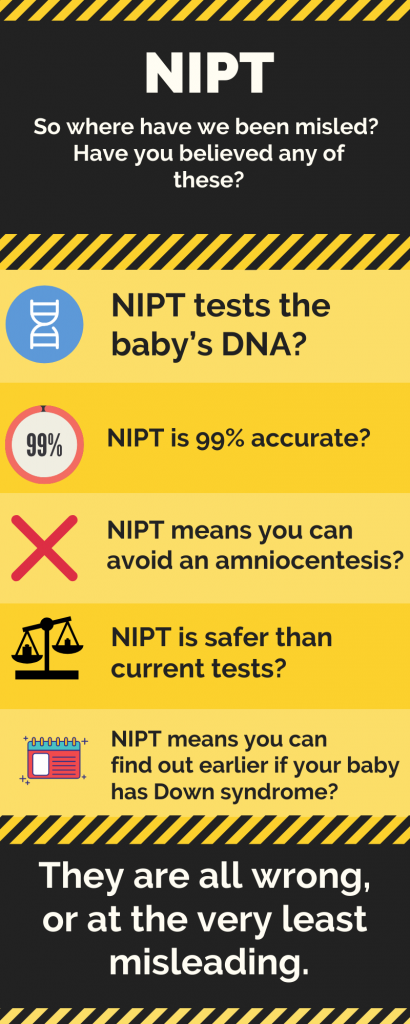
Dispelling the myths
Non-invasive prenatal testing uses fetal DNA, but fetal DNA does not translate to being the baby’s DNA. It is actually placental DNA that is tested. Why does this matter? Because the placental DNA can be different from the baby’s DNA, (although both are produced by fetal DNA), in a condition called placental mosaicism. This is one of the reasons that NIPT is unlikely to ever be 100% accurate. However, calling it the baby’s DNA makes NIPT seem more accurate than it is.
“It is actually placental DNA that is tested.”
Which brings me to accuracy. When a woman asks, “How accurate is the test”? what she is really asking is “How likely is it that my result will be correct?”. When a clinician asks it, they want to know “How many of all the babies with Down syndrome there are, will the test pick up?” Two very different questions. The answer to the second question is within the region of 97-99%. However the answer to the question women are actually asking is the Positive Predictive Value. And if you are in your 20s, the positive predictive value is as low as 46%. On a yes/no, 50:50 question. But those figures don’t sell tests. They might however, prevent a woman having unnecessary investigations during their pregnancy, or worse, an abortion based on misinformation. There is a calculator here for your PPV https://www.perinatalquality.org/Vendors/NSGC/NIPT/
 “And if you are in your 20s, the positive predictive value is as low as 46%.”
Therefore, considering these “accuracy” figures, you definitely can’t avoid an amniocentesis by having NIPT, unless you don’t really want to know for sure. In which case, you may want to ask yourself why you are having testing in the first place, unless you like to gamble. The test can be wrong both ways. It can tell you your baby does have Down syndrome when she/he doesn’t, and it can tell you your baby doesn’t have Down syndrome when she/he does. Therefore you do still have to have an amniocentesis to know for sure.
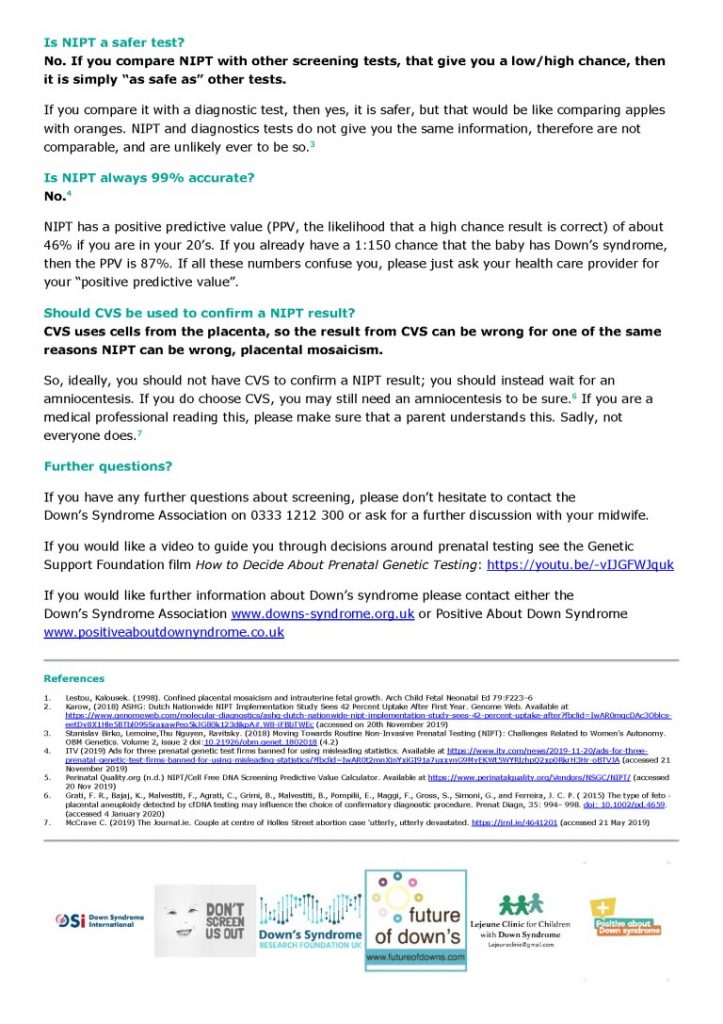
The safety statement is a red herring. It is safer than an amnio, but it doesn’t give you the same results as an amnio, so it isn’t really comparable. It is as safe as current screening tests which are also screening tests, just like NIPT.
And lastly to finding out earlier. Amniocentesis is safest when done after 15 weeks. There is another diagnostic test that can be done earlier called CVS, however, remember that placental DNA? CVS also tests placental DNA, so if NIPT is incorrect, CVS might be too. So you still have to wait for an amniocentesis to be sure. Sadly, not everyone has understood that, and the advertisers should be ashamed (The Journal.ie, 2019).
“…the advertisers should be ashamed”
For a copy of the leaflet for you or your healthcare professional click on the image below:

Prenatal Screening and Down Syndrome – million-dollar ethics
Prenatal Screening and Down Syndrome – million-dollar ethics
The Nuffield Council on Bioethics, an independent think tank on bioethics, launched their report on the ethical issues of NIPT(non-invasive prenatal testing) in 2017. NIPT, a new more accurate way of screening for Down syndrome, is part of the genetic testing market, predicted to grow to a value of $22 billion by 2024.
NIPT raises many ethical difficulties, covered by Nuffield. However, the Down syndrome (DS) community did not agree with all of its conclusions. Sally Phillips, actor, comedian and mother of a young man with Down syndrome, made this clear in her response when she questioned the difference Nuffield had drawn between screening for sex and screening for Down syndrome. “For you we still fall the wrong side of the line… leaving DS in the significant medical conditions box you are saying that discrimination against their lives does not have the right to be protected against.”
However, the report did, at least, outline some of the issues to be resolved in order to have a more ethical roll-out of NIPT. Two years on, how far have we got?
NIPT is a groundbreaking technology that uses a sample of the mother’s blood, containing maternal and placental cells, to estimate the chance that the baby will have a genetic variation. It is already in wide use in the private sector, where companies in the UK are offering parents the chance to find out if their unborn baby has a higher chance of everything from Down syndrome to deafness.
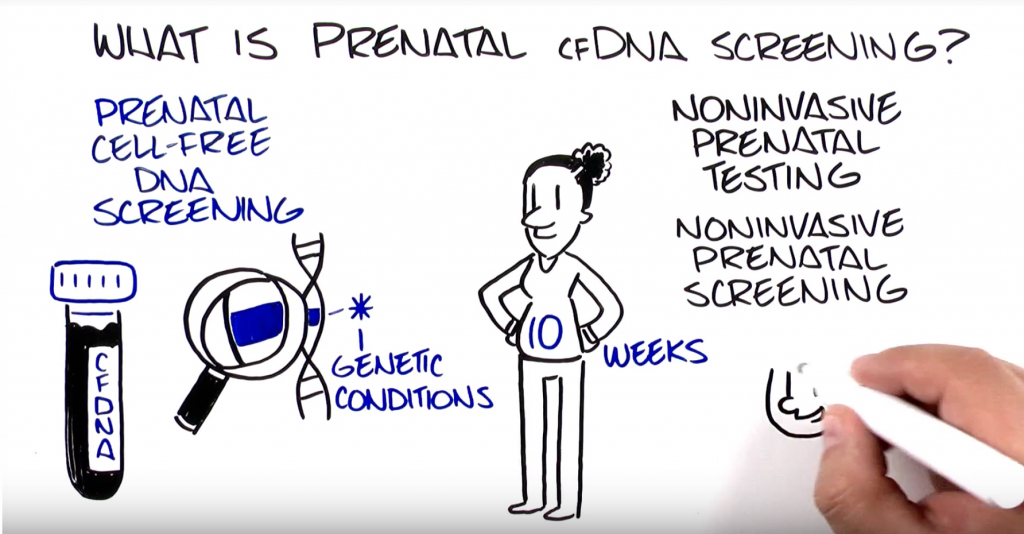
PRENATAL CELL-FREE DNA SCREENING (CFDNA SCREENING) VIDEO (GENETIC SUPPORT FOUNDATION)
Some US companies are offering prenatal genetic testing to sequence the whole genome of babies, whilst others have suggested that we will be able to use genetic testing (not specifically NIPT) to identify the chance of the embryo having a low IQ. Further, a patent has been issued for using genetic testing to analyse unborn babies for the chance that they may have autism.
Back in the UK, the National Screening Committee announced their approval of the use of NIPT in the NHS screening pathway in October 2016, on a Saturday, in the Guardian, without waiting for Nuffield’s final report. However, although roll-out of free NIPT tests in the NHS was planned for October 2018, it is not yet officially part of the screening pathway. The hold-up was legal rather than ethical and that may soon be resolved. However, so far most of the ethical issues raised by the Nuffield report have not been addressed. I cover four main ones below:
- There continues to be no national care pathway for women wishing to continue their pregnancy following a high chance or positive result from testing (20, Nuffield Report). Neither NICE nor the Royal College of Obstetricians and Gynaecologists (RCOG) have prioritised this in the last two years. What little guidance there is remains buried in RCOG guidelines entitled Termination of Pregnancy for Fetal Abnormality published in 2010. Nuffield strongly suggested that the name of this guidance should be changed immediately to reflect the inclusion of continuation of pregnancy guidance and that that section should be substantially expanded, or separate guidelines should be produced.
- Misinformation continues to abound around what NIPT is and what it can do (6.8, Nuffield report). NIPT is a more accurate screening test, but it is not a replacement for a diagnostic test such as amniocentesis or CVS. Further, tests are evaluated by different measures, the difference between these appears to continue to elude manufacturers, clinics, midwives, consultants and the media. Sensitivity measures what percentage, of all tested fetuses that have the variant, the test will find. Positive predictive value of a result is how likely your high chance result is to have correctly identified the baby as having Down syndrome. NIPT will pick up 99% of babies in some populations, although the bias of available studies has been questioned by the Warwick systematic reviewers. However, if you are a pregnant woman, interested in how likely your high chance result from NIPT is to be correct, then the positive predictive values range widely, starting about 46%, depending on your age and combined screening test results. There is a useful calculator here.
- Nuffield also recommended that private companies be regulated, and their advertising controlled by the Committee for Advertising Practice (6.39, Nuffield report). There are now CQC inspections, but it isn’t making much difference to the misleading information being given in the advertisements.
- Genetic counsellors remain few and far between, and despite Nuffield highlighting this as a need, (6.30, 6.36, Nuffield Report) little has been done. Some courses to train already stretched midwives have been offered, but this has hardly plugged the gap. ARC( Antenatal Results and Choices) are offered as a solution. However, they haven’t collaborated with Down syndrome charities, as was suggested, And, although, the Nuffield report found them to be non-directive, the following facts call the usefulness of their helpline into question:
- they were formally known as SAFTA, (Support After Termination for Abnormality);
- they have received donations from manufacturers of NIPT totalling £11,500 from 2014-2017;
- their booklets strongly orientate towards the difficulties of continuing your pregnancy and they offer no support groups for women continuing their pregnancy.
What is needed is an NHS helpline staffed by trained genetic counsellors to help patients process all the prenatal genetic information that is now available. This has been called for by the Down Syndrome Association. The need was also clearly demonstrated, by a case in the press recently, where a woman was given a high chance result from a private clinic for Turner syndrome, with all the associated worry and suggestions of invasive testing only to realise, after much research, that her result was approximately only 40% likely to be correct.

The front cover of the new version of the leaflet
Some things have been done. For example, heads of screening in each NHS Trust have received training and Public Health England have revamped their Screening for You and Your Baby booklets and produced template letters for issuing test results. However, these are still not being used everywhere, with one woman recently receiving a letter saying “We are pleased to inform you that the blood test….. shows you are at low risk for Down’s syndrome’. What would they say to her friend whose child does have Down syndrome – commiserations?!
In this landscape it is very hard to see how women can make truly informed choices. And anyway, genetics do not tell you who your baby will grow up to be. They could be a famous actress like Sarah Gordy, or a Special Olympics swimmer like Shauna Hogan. They may marry the love of their life, like Maryanne and Tommy Pilling, have more complex needs that mean they need full time care, or like the majority, be somewhere in between. Everyone, including those with Down syndrome, are, thankfully, far more than their genetics.
Where does this leave us?
The NHS used to be for healthcare, but it is now far wider ranging than that. The technology is moving apace, and the UK is aiming to be at the forefront of the genetic revolution. We need to decide what place we will allow ethics to play in the face of this multi-million-dollar industry. And if we will allow ourselves to listen to the quieter minority voices of those whose communities are already being impacted.
Blog reproduced with thanks to CMF blog and to author Colette Lloyd who is a speech and language therapist and mother to a young adult with Down Syndrome