
Obesity and Down’s Syndrome
GO-DS21 FINAL recruitment NOW!
Are you interested in making a meaningful difference in Down Syndrome research? Join the GO-DS21 study, a research project exploring the causes of obesity in people with Down Syndrome and understanding the impact of genetics on conditions related to Down Syndrome.
The GO-DS21 study is led in the UK by Professor Andre Strydom from King’s College London and Dr. Li Chan from Queen Mary University of London, both renowned experts in the fields of intellectual disabilities and molecular endocrinology and metabolism. Their primary goal is to uncover the complex connections between Down Syndrome and obesity, with the ultimate aim of improving the health outcomes of individuals with Down Syndrome.
In April Dr Corcoran from the Foundation had a chat with them on a Facebook live to better understand the study and how to get involved:
By participating in this study, you can help researchers gain a better understanding of the underlying genetic and biological factors that contribute to obesity and other conditions associated with Down Syndrome. This knowledge can then be used to develop new treatments and interventions that can improve the health and well-being of individuals with Down Syndrome but also others with Learning disabilities too.
To learn more about the GO-DS21 study and register your interest, visit their website at https://go-ds21.eu/. or email downsyndrome@kcl.ac.uk
Together, we can make a meaningful difference in the lives of individuals with Down Syndrome and their families.


Down Syndrome Innovation Conference 2023 -Special Offer for UK followers

We have partnered with the host of this conference, Down Syndrome Options, to invite parents and professionals interested in supporting individualised paths for optimal growth and development for children with DS, without discrimination or breaking the bank. It will be available via Live Stream with a discount code for our UK followers (discount code: UK100) book here.
What time is it showing in the UK?
Watching the Livestream of the conference will start at approx 12:45pm UK time until 22:00… but don’t worry you will have access to watch the conference live and later at your convenience as it will be recorded.
Who is speaking?
Rory Feek, Parent, Singer-songwriter
Rachel Coleman, Creator & Host of Signing Time!
Carol Brown, Executive Director, Equipping Minds, Cognitive Development Curriculum: a Foundational Tool for Learning
Lois Laynee, Founder, AZ Sleep Apnea Center, Optimizing Growth & Development with Cranial Nerve Integration
Dr. Theron Hutton, Parent, Pediatrician, Practicing Common Sense
Linda Kane, M.CND, Parent, Neurodevelopmental Therapist, Hope and a Future, Exploring Neurodevelopmental Therapy
Darcy Day, Parent, Spell to Communicate Practitioner, Hope for the Struggling Communicator
Dr. Erica Peirson, Parent, Naturopathic Physician, The Importance of Optimizing Gut Health. She has lectured nationally and globally sharing with others the many ways to optimize the health of people with DS. She sees patients from all over the world through her private, telemedical practice. She is also the proud mother of a healthy, thriving 15-year-old son who has benefited from her expertise.
Alissa Hodgson, Certified Functional Diagnostic Nutrition Practitioner, Board Certified Holistic Health Practitioner, Targeted Nutritional Intervention: the Science & Practical Application
Sarah Wilkinson, Parent, Chiropractor at Holistic Healing and Chiropractic Center, Synchronizing Options to Maximize Reflex Integration
Jane Winans, MA, Parent, Educational Coach, Victory Lap Mindset, Minimize (Parental) Meltdowns, Avoid Bankruptcy, & Find Humor in this Wonderful, Challenging Opportunity Called Life
Lydia Winans, Young Adult Self-advocate, Taking Charge of My Own Health & Fitness
Andi Durkin, Parent, Executive Director, Down Syndrome OPTIONs, Navigating through Crisis to Connection for Action
What if I want to go to the event in person?
The event is being held in Tennessee in the town of Columbia. Come to Homestead Hall, a charming refurbished farm at Hardison Mill, to hear dynamic practitioners, therapists, educators, and advocates share inspiration and innovative solutions to improve the health, cognition, sleep, and development of individuals with Down syndrome. Plus, enjoy heart-warming entertainment from our DS community including music from Rory Feek and a short, awarding-winning film, For Paloma written by April Aguilera, parent of a child with DS.
For those attending in person the conference will be from approximately 8 AM-5:30 PM on Friday and Saturday with lunch provided. Elyse Mundelein, Zumba instructor/adult with DS will lead us in fun movement breaks. You’ll also have plenty of time to check out the booths in the exhibit area that support these innovative strategies.
View the Facebook live video of Foundation chair Dr. Corcoran with Andi Durkin from Down Syndrome OPTIONs to discuss the upcoming 2023 Down Syndrome Innovations Conference on Feb. 24-25th which will be held in Columbia, TN but can be watched via Live Stream!

To book don’t forget the discount code for our UK followers (UK100) book here.
Don’t Miss the Boat!
The window of opportunity to input to the Government’s Call for Evidence (CfE) on the Down Syndrome Act is almost closed. The Department of Health and Social Care will close their CfE on 8th November. We strongly urge you to add your thoughts to their process. The CfE is online and can be accessed here . Easy Read versions here.

Alongside the Government’s evidence gathering, the National Down Syndrome Policy Group (NDSPG) is running its own consultation, looking in more depth across the areas of health, education, social care, employment and housing. The NDSPG’s consultation will also close on 8th November.
The NDSPG’s consultation follows two phases. Phase 1 is open ended and welcomes all points of view across the areas of health, education, social care, housing and employment and can be accessed here.
Phase 2 seeks to get more detailed information and focuses on three groups – parent/carers, adults with Down syndrome and professionals supporting people with Down syndrome. All of the surveys (together with PDFs copies to look at ahead of completing) can be accessed at https://ndspg.org/
The links for the questionnaires specifically for parents/carers can be found below:
Transitioning to adult social care
Social care for children / young people under 18

The links for questionnaires specifically for adults with Down syndrome can be found below:
The following link is specifically for professionals supporting people with Down syndrome:
Again, we encourage you to take a look at the surveys and complete whatever you’re happy to. All views will be fed into the DHSC’s process with the aim of ensuring the guidance the Government publishes is effective, clear and provides a strong foundation for services provided to support people with Down syndrome.
Please let us know if you have any questions.
Calling for more evidence – Down Syndrome Act 2022
Thanks to widespread public and political support, we now have a Down Syndrome Act! Thankfully the Foundation and it’s trustees worked together with the National Down Syndrome Policy Group (NDSPG) to have a voice and be involved in the passing of the Act. We are here with an important update on where we are in the progress towards it’s implementation.
The Down Syndrome Act requires the Secretary of State to publish statutory guidance about the specific needs of people with Down syndrome which health, social care, education and other local authority services (such as housing) must take into account when commissioning or providing services. Once the guidance is published these authorities are legally required to take the guidance into account when providing certain core services.
The NDSPG we believe it is vital that those with Down syndrome, their families, carers, friends and experts working with them, contribute to the guidance in a meaningful way because they understand the frustrations and limitations of current systems and also have many views about how to improve things. They know what works and what doesn’t, what is helpful and what is a hindrance, what is beneficial and what is a waste of time.
But they need to hear from you!

We are pleased to announce the launch of the second phase in the NDSPG’s online consultation. In phase 2 they move into a more quantitative approach, asking specific questions.
They appreciate that not all of you will have experience across all of the topics, so they have created individual questionnaires split into three different respondent types:
To be completed by Parent / carer
- Education
- Transitioning into adult social care
- Social care for children / young people under 18
- Healthcare
To be completed by individual with Down syndrome, with assistance where necessary
To be completed by professionals who help people with Down syndrome
The NDSPG appreciate that some of you may feel daunted by the task of completing these surveys. An alternative might be to hold face to face meetings with your local group/peers to get feedback in person. Please get in touch if you would like to do this but need support in how to facilitate.
In addition to our consultation we recommend as many people complete the Government’s own Call for Evidence
Research Assistant Required
The NDSPG are also looking for postgraduate students to support as Research Assistants working on the analysis of qualitative data. Please email contact@ndspg.org to discuss terms. Please do share this great opportunity to work with a dynamic team as they analyse the data from our consultations and present to the Government as part of their call for evidence for the Down Syndrome Act.
Queen Signs Historic Down Syndrome Bill into Law
Yesterday the Queen signed into law an Act of Parliament focussed on improving outcomes for people with Down syndrome and their families. The new ‘Down Syndrome Act 2022’ is understood to be the first of its kind in the world.
The Rt Hon Dr Liam Fox MP, a former NHS Doctor and GP, introduced the ‘Down Syndrome Bill’, as his choice of Private Members’ Bill after he successfully secured a Ballot Bill in the House of Commons this session. Dr Fox broke the news today on his social media accounts that the Queen had given her assent to his Bill, making it law.
It is rare for a Private Members’ Bill to become law. Dr Fox, an MP for some thirty years, secured both cross-party and Government support. As a result, the Down Syndrome Bill passed through both the House of Commons and the House of Lords without objection. Previous attempts by other members of Parliament to bring forward Bills with a broader remit around learning disability have failed.
An open letter was published last month by the National Down Syndrome Policy Group (NDSPG) who have championed the Bill. The open letter urging members of the House of Lords to ensure that the Bill completed its passage had the support of over a hundred organisations including Mencap.
The Down Syndrome Act will come into immediate force and there will now be a public consultation undertaken by the Government to inform development of the necessary guidance for public bodies.
Dr Liam Fox MP, the Down Syndrome Bill Sponsor said:
Tommy Jessop, actor from BBC’s Line of Duty crime drama and NDSPG Ambassador said:
Peter Brackett, Chair of the NDSPG said:
For more information, see the National Down Syndrome Policy Group website ndspg.org or email contact@ndspg.org
For media interviews with Dr Fox please contact David Goss goss@parliament.ukor call 07972 790445
For interviews contact:
- Ken & Rachael Ross MBE on 07710 612 807 kenross@portsmouthdsa.org
rachaelross@portsmouthdsa.org - Lynn Murray on 07840 966736 or email murray@dspg.uk
- Peter Brackett on 07515 121733 brackett@dspg.uk
Down Syndrome Bill https://publications.
Successful Private Members’ Bills since 1983 https://
Down’s syndrome legislation ‘gives people a voice’ https://www.bbc.co.uk/news/uk-
‘Historic’ moment as support for people with Down’s Syndrome written into law https://www.telegraph.co.uk/
People with Down syndrome who are trustees of the Down Syndrome Policy Group welcome the introduction of the Down Syndrome Bill: Launch of The Down Syndrome Bill – YouTube
‘It’s time for us to live our lives to the full’: Line of Duty’s Tommy Jessop on changing the world for people with Down’s syndrome https://www.theguardian.com/
NDSPG Open letter in support for the Down Syndrome Bill https://ndspg.org/media/
The impact of the COVID-19 pandemic under 11s
At the Foundation we have been highlighting the issues faced during the pandemic by our community by Covid-19 itself but also the unintended consequences of the pandemic such as delay in assessments for dual diagnosis, health screening or routine care. We’re excited to highlight these new surveys and encourage you to share your experiences.
New Survey on the impact of the COVID-19 pandemic on children under 11 years old who have Down Syndrome

Are you a parent/carer of a child under the age of 11 who has Down Syndrome or know someone who is? Do you live in the UK?
Led by Professor Monica Lakhanpaul (UCL) has teamed up with the Down’s Syndrome Association and Trisomy 21 Research Society to develop a survey to understand the impact that the pandemic has had on children under the age of 11 who have Down Syndrome. They hope that this information will teach them how best to support children with Down Syndrome and their parents/carers going forward.
The survey covers a variety of areas that you may have noted a difference in your child since the pandemic.
If you qualify to take part, take 15 mins to answer this survey and/or share with those who may be eligible: https://redcap.idhs.ucl.ac.uk/surveys/?s=AAJFERD88RF94NLF
MyNeuroSurvey from the Neurological Alliance
Getting the right care, treatment and support at the right time can make a life changing difference when you have a neurological condition, like epilepsy, ASD or ADHD. But there are huge variations across the UK – not everyone with a neurological condition in the UK has access to the same high quality, joined up care and support.

By sharing your experiences, you’ll help to gather the evidence to make the case for change. My Neuro Survey is completely anonymous and secure. Suitable for adults and children.
Or call the survey partners, Quality Health on 0800 783 1775 (Freephone) to:
- hear and complete the survey over the phone in 150 languages
- ask for a paper copy to be sent to your address
- ask for a large print version
- ask for an Easy Read version of the survey
The survey takes around 20 minutes to complete. Your answers will help improve services for people with neurological conditions across the UK.
Data from previous surveys has been used to improve services in hospitals, develop new specialist centres, and spark debate in Parliament. The survey takes around 20 minutes to complete. Please take part and make your voice heard.
Thank you to everyone who has taken part so far – your responses make the neuro community heard and seen.
Did you see?
Our chair recently co-authored a paper “The COVID-19 pandemic should be last orders for poor care of people with neurodevelopmental disorders.” with Professor Andre Strydom and Dr Anne-Sophie Rebillat.
You can read it here.
New study on Probiotics and Constipation in DS
We at the Foundation are over the moon about sharing this new research project from UCL with you! Now, it might seem odd to be so excited about stool and constipation in Down’s syndrome but it is a serious issue in our community. Our recent survey showed around 30% of 2-6 year olds are on medication for constipation, and it’s a problem that doesn’t go away as they get older. Constipation and its treatments are often a spanner in the works for toilet training and getting ready for school.
A research team at UCL, led by Prof Simon Gaisford, is conducting a trial looking at whether constipation and gut health in children and young people with Down’s syndrome can be managed with probiotics.
New research has also begun to implicate gut health and barrier integrity (intestinal permeability AKA ‘leaky gut’) in all sorts of neurological conditions including Alzheimer’s disease. This research will be an important piece in the puzzle of understanding the complex difficulties our loved ones face.
Prof Simon Gaisford from UCL School of Pharmacy who is heading up the project has investigated the effects of probiotics on other conditions and is passionate about helping our community to have better gut health and is excited about potential benefits to their development too. Hear more about the study from him below but join us for an exclusive Facebook Live chat on the 23rd November at 18:30 UK time
The trial, which will commence in January 2022, will involve children or young people with DS taking a liquid probiotic once per day, first thing in the morning on an empty stomach, over the course of 12 weeks. Parents or carers will be asked to rate the child or young person’s constipation at the start, during and at the end of the trial using a simple questionnaire. The UCL team has partnered with Down Syndrome UK, Positive About Down Syndrome, Down’s Syndrome Research Foundation UK and 21 Together to reach out to the DS community and help recruit participants.
They are looking for children and young people (anyone aged under 18 on 1 Jan 2022) with DS. To be eligible, participants will have diagnosed constipation with or without other gut symptoms. To learn more about the study you can download the leaflet here: DS Information Leaflet FINAL
If you would like to register your interest in your child or young person taking part in the trial, please fill in the online form available here; https://forms.office.com/r/
We encourage you to take part in this amazing opportunity to help scientists learn more about this issue.
A big thank you to Prof Gaisford and team for doing this research and helping make a better tomorrow for our loved ones.
REFERENCES
- de J R De-Paula V, Forlenza AS, Forlenza OV. Relevance of gutmicrobiota in cognition, behavior, and Alzheimer’s disease. Pharmacol Res. 2018;136:29-34. doi:10.1016/j.phrs.2018.07.007
- Hiippala K, Jouhten H, Ronkainen A, et al. The potential of gut commensals in reinforcing intestinal barrier function and alleviating inflammation. Nutrients. 2018;10(8):E988. doi:10.3390/nu10080988
- Spielman LJ, Gibson DL, Klegeris A. Unhealthy gut, unhealthy brain: the role of the intestinal microbiota in neurodegenerative diseases. Neurochem Int. 2018;120:149-163. doi:10.1016/j.neuint.2018.08.005
- Vanuytsel T, Vermeire S, Cleynen I. The role of haptoglobin and its related protein, zonulin, in inflammatory bowel disease. Tissue Barriers. 2013;1(5):e27321. doi:10.4161/tisb.27321
- Fasano A. Zonulin and its regulation of intestinal barrier function: the biological door to inflammation, autoimmunity, and cancer. Physiol Rev. 2011;91(1):151-175. doi:10.1152/physrev.00003.2008
- Wang W, Uzzau S, Goldblum SE, Fasano A. Human zonulin, a potential modulator of intestinal tight junctions. J Cell Sci. 2000;113(Pt 24):4435-4440
- https://www.ncbi.nlm.nih.gov/pmc/articles/PMC6326209/
The 2nd Reading of the Down Syndrome Bill
Today the DS community and its supporters are celebrating. The Private Members Bill proposed by Dr Liam Fox has received government backing meaning there is every confidence it will move forward successfully through the 2nd reading on the 26th of November.
The National Down Syndrome Policy Group, a coalition of leaders within the community, has been supporting Dr Fox’s office and campaigning to make this a reality. The first fruits of the All-Party Parliamentary Group for Down Syndrome the long overdue Down Syndrome Act holds great promise to improve the life chances of all people with Down syndrome.
The Founding Officers of the NDSPG who have Down syndrome prepared a short video highlighting some of the areas where they hope to see positive change in the future. Launch of The Down Syndrome Bill – YouTube
The journey of a Private Members Bill through Parliament is shown below:
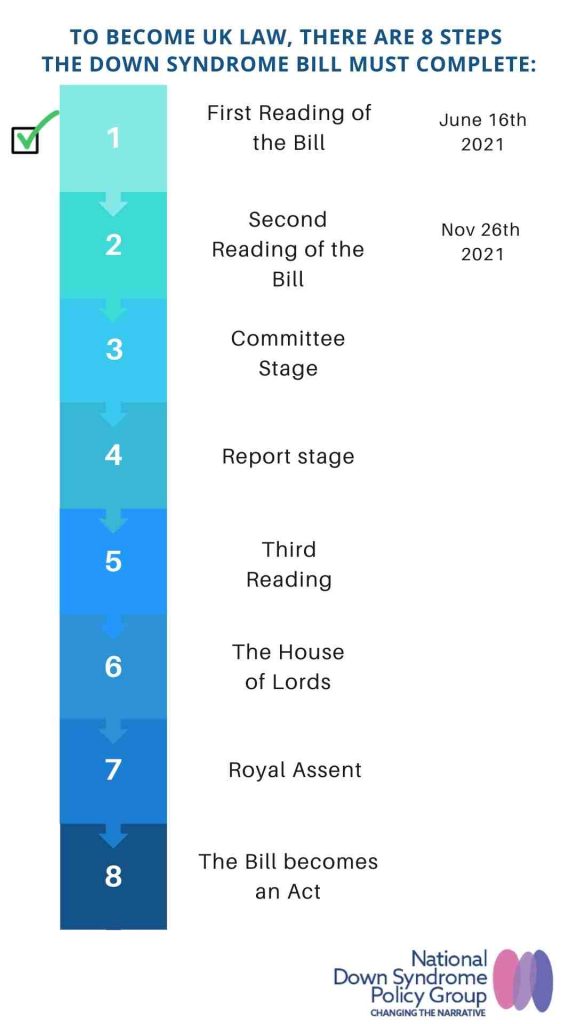
The NDSPG held an informative webinar to bring the community up to date that you can view here, be sure to follow them to be notified of further meetings.
A great gathering is planned on the 26th November outside Parliament and you are invited to join the party! To learn more see the event page and let us know you can come.

Social Cognitive Strengths and Difficulties in Down’s Syndrome
Lauren Jenner, who is a PHD student at the University of Surrey, is looking for children and young people who have Down’s syndrome (ages 4 to 17 years) ( both with and without a diagnosis of Autism Spectrum Condition (ASC) ) to take part in a study. Our chair, Dr Corcoran, had an informal chat with her about the project and why parents might like to be involved that you can watch here.
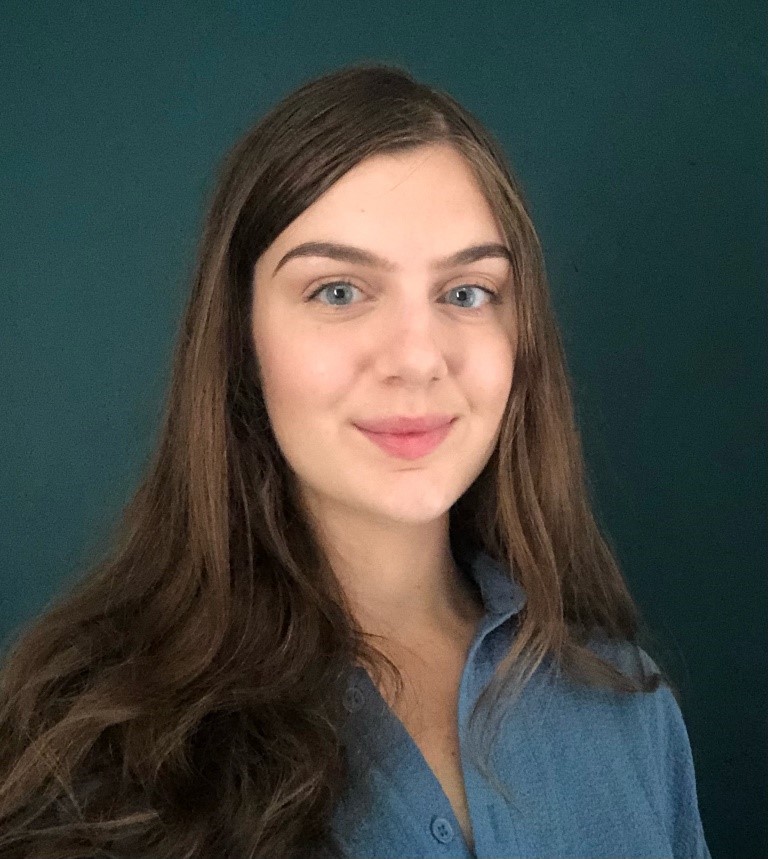
Lauren is researching how children and young people who have genetic syndromes process and understand social information. She aims to identify whether there are social processing differences characteristic of specific syndromes, and how these may relate to the presentation of autism traits.
People who have Down’s syndrome who take part in Lauren’s study will be asked to undertake:
- Some tasks and activities that demonstrate their social skills, verbal, and non-verbal abilities.
- Eye-tracking assessments which show the research team where a person is looking on a screen, giving them information about what that person finds interesting.
Parents will be asked to fill out some questionnaires and complete an interview over the phone.
Testing will be carried out remotely wherever possible. Remote testing sessions can be broken down into a number of short test sessions with rest breaks where needed. Overall, the whole study will take approximately 2-3 hours to complete. The research team will try and complete any face-to-face testing within one visit.
There is further information about the study here:
If you would like to take part in this study, have any questions or would like to discuss the study in more detail, please do not hesitate to contact Lauren using: l.jenner@surrey.ac.uk
BACKGROUND
Lauren and her colleagues are interested in how people who have Down’s syndrome process and understand social information such as faces, eyes and emotions. They would also like to know how social information processing relates to observable social behaviour skills that are central to navigating day to day interactions in people who have Down’s syndrome.
Since some people who have Down’s syndrome also meet the criteria for a diagnosis of ASC, Lauren is interested in whether individuals who have Down’s syndrome with and without ASC process social information in a way that is similar to or different from people who have ASC without a genetic syndrome. Lauren and colleagues hope that this work will lead to improved understanding of the social-cognitive strengths and challenges that are characteristic of individuals who have Down’s syndrome, those with other genetic syndromes associated with intellectual disability and people who have ASC with and without a genetic syndrome.
We asked Lauren how she believes her study may benefit people who have Down’s syndrome and their families:
‘Generating causal models that explain pathways contributing to variable risk for autism and phenotypic heterogeneity among individuals with Down syndrome will support greater precision in assessment and intervention that is informed by syndrome specific profiles.
‘Employing measures of social cognition which are accessible for those with intellectual impairment and/or limited language will support inclusion of individuals with Down syndrome in social cognitive research – addressing a current gap in the literature. Together, this research will advance understanding of autism in Down syndrome and help mitigate gaps in clinical services (Reilly et al., 2015, Thurm et al., 2019). Additionally, parents/caregivers can receive a personalised feedback report and/or a summary of the key findings from the study, which may be used to support their child (e.g., when seeking an autism assessment and diagnosis). There will be a clear statement at the top of each personalised feedback report highlighting the report is not a clinical report but results of a research study. Parents/caregivers are always advised to contact their GP or other appropriate professional if they wish to have clinical input.
‘In short, this work is imperative for understanding how individuals with Down syndrome process social information and whether this is related to the presentation of autism. It also will advance measurement of social cognition in this population. The ultimate key beneficiaries of the project will be individuals with Down syndrome, their families, and researchers investigating neurodevelopmental conditions.’
OTHER MEMBERS OF THE RESEARCH TEAM
 |
 |
| Dr Jo Moss is a researcher and lecturer at the University of Surrey. Through her research, Jo aims to further understand social, emotional and cognitive diversity in individuals with genetic syndromes. | Profesor Farran is a psychologist with expertise in children’s spatial abilities and how this relates to mathematics and science competence, and in understanding spatial learning difficulties in individuals with neurodevelopmental disorders. |