
Concerns about the McArthur Assisted Dying Bill in Scotland in relation to Down’s Syndrome
The Down’s Syndrome Research Foundation UK recently sought the opinion of people in Scotland about the currently debated McArthur Bill on Assisted Dying, regarding issues with consent and coercion in relation to people with Down syndrome. The McArthur Bill in Scotland would legalise assisted dying for terminally ill adults over the age of 16 who meet the required criteria. The legislation is in the final stage of the Scottish Parliamentary process, and MSPs are currently debating amendments to the Bill. The final vote by MSPs is scheduled for Tuesday 16th March 2026.
Polling was carried out by independent body Whitestone Insight. The majority of people who participated in the polling expressed concerns. Some highlights of the polling include:
Three-quarters (75%) of Scots said they were concerned that it would be difficult to establish whether a person with a learning disability, such as Down’s Syndrome, would be expressing voluntary informed consent if they applied for assisted suicide. Only 14% reported being unconcerned.
Two-thirds (67%) of Scots said that a person with a learning disability, such as Down’s Syndrome, might be particularly vulnerable to the risk of coercion or manipulation into an assisted suicide if it became legal. Only 20% disagreed.
Dr Elizabeth Corcoran from the Down’s Syndrome Research Foundation UK says:
“This polling shows Scots are deeply concerned about the negative impact that legalising assisted suicide will have on people with intellectual disabilities, such as Down’s syndrome.
We are deeply concerned about the risks of coercion and undue influence in relation to the proposed change to the law. In particular, people with Down’s syndrome and people with intellectual disabilities in general are at significant risk of coercion and undue influence, in part due to their need to trust and build understanding for their needs with caregivers and medical professionals.
There is a very real risk that, if passed, this legislation could be applied far beyond its original intention. It may be stretched to include people who are not at the end of life, but who are instead viewed as having lives that are devalued through discriminatory attitudes and narratives. For our community, that possibility is terrifying.
This concern is not hypothetical. The committee examining the proposed legislation has recognised that the bill may be challenged under the European Convention on Human Rights, resulting in eligibility being widened. Should that occur, there is every chance that eligibility could be widened. No one, not this Parliament, nor any future one, can guarantee how such laws will be interpreted or expanded over time.
Disabled people in Scotland already struggle to access the care and support they need, with nearly three-quarters of respondents to a recent Inclusion Scotland survey stating they had “problems accessing services from their local council”. Rather than legalising assisted suicide, a more appropriate use of scant public resources would be to redouble efforts in Scotland to remove barriers to care.
We are calling on MSPs to ensure our community is protected and vote against the McArthur Bill at Stage 3.”
DSRF UK is concerned that, as with Kim Leadbeater’s Assisted Dying Bill, the human rights and needs of people with Down syndrome have not been fully considered, and the risks that the Down syndrome community faces in relation to assisted dying legislation is not widely understood.
We urge you to contact your MSPs in this crucial moment as they consider their vote.
Assisted Dying Bill Updates
Last Stages involving MPs
We now have a quick email tool available to use to contact your MP, asking them to cast their final vote against Kim Leadbeater’s Assisted Dying Bill. As we have mentioned in previous blogs, we consider that this piece of legislation will change the whole landscape of care in a way that will detrimentally affect people with Down syndrome, as well as many other people.
This Friday, MPs will gather in Westminster, preparing to vote for or against the Assisted Dying Bill for the last time. After this, if the Bill progresses, the chance to stop assisted dying passes out of MPs hands.
It’s a critical time to reach out and let your MP know that you have urgent and serious concerns, and do not want them to vote in favour of the Bill. The upcoming date is:
Friday 20th June 2025: Final Commons Vote at the Third Reading
- The elected members of parliament who represent us will decide if they will let the Bill pass, and then responsibility to stop it or move it onwards passes over to the House of Lords.
- On this day your MP will vote for the final time on whether Assisted Dying will become legal in the UK.
Some important things to remember:
- MPs Daniel Francis and Sarah Olney who served on the Bill Committee have spoken out strongly at the recent Report Stage proceedings in Westminster, about how the Bill will affect people with intellectual disabilities – they claim that legitimate concerns are unaddressed and the Bill is unsafe for people with disabilities of any sort
- All proposed amendments to the Bill that would have safeguarded people with intellectual disabilities, including those with Down syndrome, were voted down by the majority pro-euthanasia Bill Committee
- Many major concerns have repeatedly emerged, with some MPs declaring openly that they will switch sides due to their concerns
- The vote looks like it will be very tight because of shifting opinion – and that’s why your communications to your MP could truly make a difference, even at the last minute
You can find the email tool here – it takes only seconds to send a letter to your MP. Thank you for all your efforts on this profoundly important issue.
“You shouldn’t be dying just because someone else has deemed you unworthy.”
DSRF was privileged to speak recently with Jen, who has an eye-opening perspective on the Assisted Dying Bill, as a healthcare professional and a mother in the DS community. As we approach the final vote for MPs on Friday 20th June, Jen’s story is a must-read. Please share this story with anyone who has not yet realised the wider context that Assisted Dying will fit into, and how this change in the healthcare climate will affect people with DS.
I’m Jen, mother of D. who is 24 years old and has Down syndrome, and we are from Northwest England. I have been feeling moved to speak out recently to warn people about the dangers of the Assisted Dying Bill. I don’t think people have a clue how dangerous it is to introduce this as a law.
What is your background?
I am qualified as a Registered General Nurse, and worked as an advocate for children with disabilities for short time. I have worked as a family group conference coordinator to support families to develop a plan to prevent children going into care. I was also involved as a lay assessor when the Quality Outcomes Framework for GPs was introduced with regards to accessibility. I have worked in adult social care as a Care Coordinator / Assessment Support Officer. I am also a ‘Partners in Policy Making’ parent, and trained by a family rights group – they gave me an eye-opening training course, about personalisation, choice and control.
I am now retired. First and foremost, I’d describe myself as D.’s Mum – she is my raison d’etre and greatest joy.
With all the professional experience I have gathered over the years, I know how things work from the inside, and that’s why I can’t ignore the dangers and the attitudes that I know will shape the direction this Bill will take in practice. Back when I did nursing, we used to refer to people as ‘the hysterectomy in bed 5’: we’ve moved on and learned a lot more since then, but the dehumanisation definitely still exists, and I’m constantly on the watch for it.
Once we start with assisted dying, rates of use will go up and the system will get away with it, like they are doing in care homes already with DNARs (Do Not Attempt Resuscitation orders). Working in adult social care, I saw with my own eyes how blanket orders of DNAR were given out, to people with dementia and to other vulnerable groups. During Covid, a disproportionate number of people with intellectual disabilities died. There are so many reasons why I am worried about the Assisted Dying Bill, and it’s all from what I have experienced and been through.
I’m quite feisty and well equipped to fight for our rights, but I’ve seen that when some people get into a crisis in a hospital, they get ‘white coat syndrome’ and assume that the doctors always know best. However, the doctors don’t know your child. They may have training as a doctor but there is still a lot they need to know. There’s always a context that only the carer knows in depth, and unfortunately the habit of ‘othering’ the patient is very harmful and affects the kind of care they get.
What alarms you about the Assisted Dying Bill being proposed in the UK?
I think right now we’re on a timeline that isn’t progressing anymore but going backwards for people with Down syndrome. In the 1980s a lot of breakthroughs happened, and kids with Down syndrome were deemed educable, and moved out of institutions and back into the community, and life improved for many. However often the infrastructure to support these changes wasn’t there, and ground workers were often set up to fail. Now I think we’re seeing cost cutting measures, with money concerns really being put to the forefront. I am really convinced that Assisted Dying is all about money at the very bottom of the issue.
I am always guarded about things that are set up as shiny and all about doing good, because I’ve found that there can be darkness behind it. It’s a bit like family planning: it has origins in the eugenics movement. I am seeing a lot of comments from people online about who should qualify for an assisted death, describing some people as a drain, and having no value – but how do you measure value? You shouldn’t be dying just because someone else has deemed you unworthy: that’s my great concern. It’s really important for society to learn how to care and empathise, and how to slow down, because aging and death are part of life for everyone.
What do you think about general attitudes concerning people with Down syndrome?
There is a constant fight that happens around D. It’s nothing to do with her: my daughter has taught me so much and is an absolute joy. It’s a fight with society, to say she is worthy of having an ordinary life, worthy to enjoy a normal life.
This battle starts at the moment of conception: this is not just about assisted dying. About 98% of women who find out they are pregnant with a child who has Down syndrome have an abortion nowadays. You can’t tell me that 98% represents an informed choice on this. There’s a huge amount of fear and pressure put on women, and a lot of the time that’s why they terminate. It’s a really frightening slippery slope to force women on. There are incidents that are horrific and I have never been in those situations. I am so glad, however, that I didn’t have a test that would have told me D. had Down syndrome before she was born. I had a wonderful pregnancy with no pressure and I never had to justify why I wanted my child to live. I was living in Holland then, and didn’t experience any pressure there at the time, but here in the UK now it’s all medicalised. I am so glad I didn’t have to go through all that process and could just sail through my pregnancy. In the end, it’s such an unknown – you can’t really plan. Everyone thinks differently but I didn’t feel like dreams or aspirations were wrecked – I was just waiting to see the baby that was in my tummy, and it was D.
The night D. was born and the midwife told me she had Down syndrome, I held her and thought “maybe it’s just you and me now, little one, because dad might find this too much”. For me the oxytocin was rushing in and I was totally in love, but I was worried about how my husband would cope. I kept giving the baby to him all the time, and by day three he was in love too. I was wondering, ‘will she ever do this? will she ever do that?’. Now I laugh when I think about how ill-informed I was, but so many wrong things are told to mums and it’s all the information they have. Reactions of staff are often terrible, and those first reactions can inform your initial bonding with your child. One doctor asked my friend at her child’s birth: “have you noticed something about your child? He has a face you might have to grow to love.” These attitudes are not coming from the parent but show the bias of the healthcare professionals.
I’m not saying it’s easy, but we have no guarantees in life, and being a mum isn’t easy anyway. I think about my friends who are mums of teenagers: they have some different concerns than I do, but we all have concerns!
Please tell us about the challenges you have encountered in trying to get adequate care for your daughter.
I’ve seen a lot of twisting of the rules to suit what organisations want to do. For instance during lockdown when people could still go to school, I got a phone call saying that D. ‘couldn’t’ go to college: they just applied a recommendation without discussion with her or us, and made it seem like a rule. Blanket bans on people like D. being able to access college were a form of ‘othering’ and discrimination, and they were applied at unnecessary times.
D is definitely the ‘comeback kid’ – she has been through a lot and come back every time. Some things were missed when she was a baby and mistakes were made in her care. Her hips have been dislocated since she was a child, and she is now in a wheelchair. This has put strain on her heart and she gets tired really easily. It all stems from what was missed when she was a baby.
She had a Ventricular Septal Defect (VSD) surgery to repair her heart at the age of 14 months, and there were unnecessary post-operational complications, caused by a push to get beds cleared on the unit to make way for the next day’s operation list. This resulted in her having to be put on life support, on a Cardiac ECMO (Extracorporeal Membrane Oxygenation). It was the catalyst for a horrific set of events. We had to bring our young child home tube-fed, she had an extremely diffuse EEG after prolonged resuscitations, she lost all muscle tone and had to have a double ileostomy as a result of a perforated bowel from sepsis. Often we say she is like Lazarus – she has really beaten the odds to be with us still.
Some recent incidents have also been traumatic due to the way we were treated. During lockdown she went into sudden onset cardiac arrest in the early hours of the morning. Thankfully I heard her and went running in to work on her. The paramedics arrived and got her to hospital, and the very first thing the A&E consultant asked is, ‘what is her quality of life?’. She asked me this at 3 o’clock in the morning in the middle of the hospital corridor. I went nose-to-nose with her and said, ‘Don’t you dare ask me that, you would never ask this question if she didn’t have Down syndrome. Get back in the room and save her life, do what your Hippocratic oath asks of you!’
I have a lot of contacts now in healthcare, and thankfully we were granted access to D. even when she was ventilated, and I worked hard to make her humanity evident to people. I put up photos of her everywhere, and I spoke to all the staff who knew her. I was with her all the time and calmed her down when she was extubated by being there, and they allowed me to be there as part of the team. I asked them to treat her just like any other 21 year old – something that definitely didn’t happen when we were in A&E.
Everyone who meets D. loves her, but I always have to prove her worth before they meet her. Unfortunately when people see things on paper, they make biased assumptions. I had to fight to get a defibrillator implanted, and only one place was willing to fit it: after the fact they said it was the right thing to do, but it only happens after a lot of discussion and effort to humanise her to professionals.
As I get older, I think a lot like that MP Daniel Francis who spoke at the debate in Westminster recently, who asked ‘what happens when I am not there?’. He too has a daughter with a learning disability and knows this law won’t have the safeguards that are needed. I am like a lioness on her behalf, but I won’t always be there.
Does the healthcare profession value your insights or help you in ways you need?
I think professionals are most often doing what they can to help, but the bigger frame they have to fit into often doesn’t seem to value life.
It’s helpful when we are able to respect each other’s expertise, and we need each other. At this point, our GP office knows I won’t waste their time, and that I have never been proved wrong when I have a concern. They will see D. that day if I ask for it. D. can present as aclinical, but she could be in renal failure, and I know how to spot signs they can’t see. I know when she is ‘off’ simply because I know her so well.
The problem is that you can never afford to take your foot off the pedal, and without other people helping, it gets harder as you get older. Resilience is my best and worst trait. I am well informed and well educated on these issues, and sometimes that leads to people thinking you’ll get on and do it, and even do their job for them.
I asked for some support from the local hospice for advance care planning, as D. is life-limited. When it comes to my own daughter, what I can do for someone else actually can’t be done by me. I need a witness and support. I know that the Learning Disability nurses are over-stretched, but it was really disappointing that they simply posted paperwork for advance care planning through my door and left me to it. No matter how capable I am, I am still a mum who has feelings: this is my daughter and I can’t fill out paperwork like that on my own.
What do you think about the likelihood of coercion and mental capacity issues in relation to this Bill?
The communication needs of people with Down syndrome are absolutely not understood – professionals cannot get their heads around capacity and are still wrangling with the mental capacity act.
When D. was in hospital a few years ago, the charge nurse breezed in in the morning, and said “so a mental capacity assessment has been done on D. …”, and I stopped her right there and asked, ‘When??’ I was there with her all the time, and I didn’t see any mental capacity assessment being done. I was told that it was done at 3am – when we were both asleep!! Even if they had woken her, how can you carry out an accurate mental capacity assessment on someone who has been woken up in the middle of the night? That is a falsification of a document – I asked the nurse if she was simply keeping her KPIs up, and told her that this was disgraceful.
Unfortunately these kinds of bad practices already happen! They will probably introduce quotas for how many people they need to help die, and the majority of people will be totally unaware of it. They introduced the fragility scale during Covid and didn’t tell people about it, so many were forced into things they didn’t know was a possibility.
My big concern is that admin staff are just looking at numbers, and that doesn’t translate into the worth of a life.
I am really concerned about the coercion issue. My daughter is always saying ‘sorry mum, my brain is mush’, and it’s because she is tired – I reassure her and I know how to help her understand. However, when she got to the age of 18, suddenly professionals won’t discuss things with parents in the same way, and you need to go through the Court of Protection to get the right to be consulted – but who has the money to go through all that?
I am also appalled about the fact that amendments to the Bill to protect people with intellectual disabilities weren’t approved. The whole Bill is being rushed and rushed, and isn’t getting the publicity and scrutiny it needs. It isn’t Love Island, so it isn’t hitting the headlines, but we’ll all be affected by this in a much bigger way than people realise.
When people get older and tired they look to professionals for guidance and advice, and these same professionals are stretched and pressured and may have biases that they are not aware of. They may make decisions that will have horrific consequences.
They say that the Bill has strong protections like needing two doctors who agree, but DNARs also needed that, and look how that turned out. Who will vet these doctors and make sure they aren’t Dr Kevorkians? Doctors already aren’t trained in many things they need to know. I think it’s a horrific scenario.
How do you keep a positive outlook among all these serious issues?
I think in the end, death is part of life. It’s really important to focus on dying a natural dignified death, not prematurely ending life because the person doesn’t feel seen or valued. It’s possible to live and die really well even with pain, illness, age and disability. However, I always say to my husband, don’t ever pull the plug on me, because you know I will be fighting to get back! Valuing life like this has always been innate to me. I have seen families who have kids with many different conditions, and they adore and value their children’s lives. People who are on the outside don’t know the person and their value. Cost will never come into it with me – there is enough money in the world. In the 80’s we were going in a better direction than now – right now everything is commodified.
I wish I could bottle up all the love and joy I have from my daughter. She is just herself. She doesn’t often ask about how having DS makes her different – and to me, she is just my daughter. Sometimes she notices that some things aren’t fair, but I encourage her and remind her that it’s like that for everyone in some way.
There are some wonderful things we’ve been able to do recently. We were on holiday in Menorca and were delighted by the accessible beaches that could be reached by beach wheelchairs. It made me think when I came back home, we are by the ‘leisure peninsula’ of England and yet no-one with a wheelchair can access our own beaches. A friend in an organisation called ‘Make It Happen’ put me in contact with a local councilor who was able to draw down funding from the local authority and the NHS to realise this dream, and we got beach wheelchairs that people can use free of charge, with one dedicated to my daughter. She is definitely the catalyst for helping others and making their needs evident, it’s her legacy to help others access the simple pleasures that are denied to them.
Seeing my daughter’s joy every day helps me through everything and gives me the motivation to fight everything that comes in my path that is a threat to her. Right now, the new threat on the horizon is definitely Assisted Dying, and I want other parents to wake up to where this could lead.
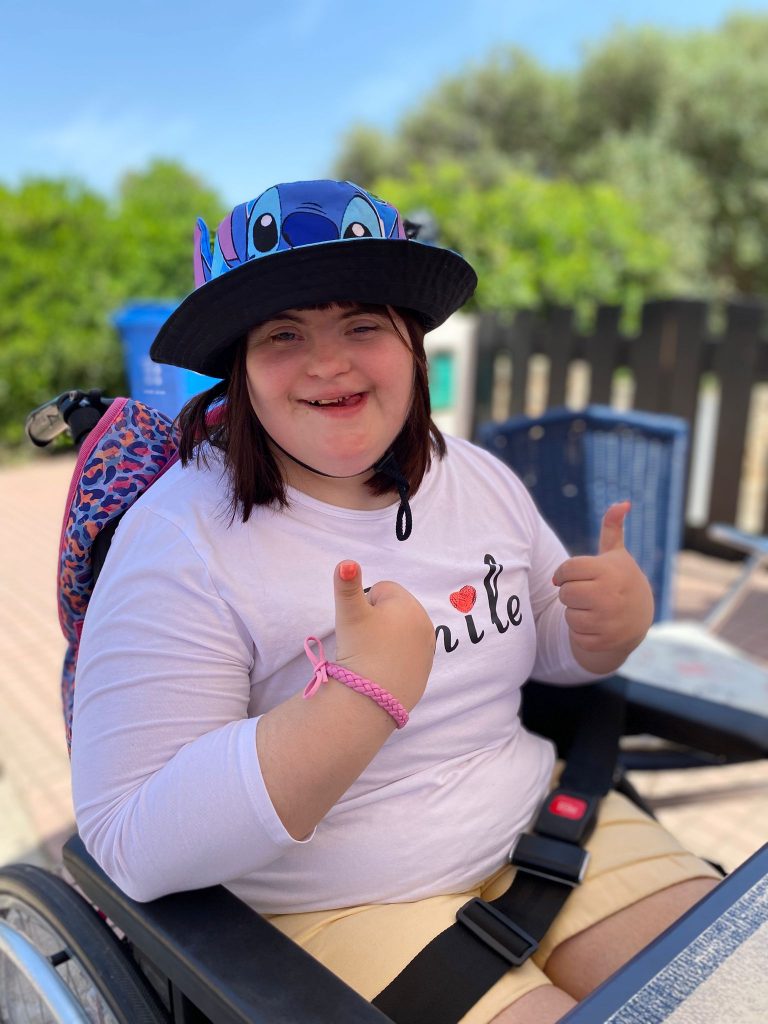
Email or call your MP if you have any doubts https://members.parliament.uk/FindYourMP
Take Urgent Action Against Scotland Assisted Dying Bill
As DSRF’s regular followers will know, we have been raising awareness about Kim Leadbeater’s Assisted Dying Bill. This Bill will affect England and Wales and is moving forward rapidly in Westminster, and we believe it will present serious dangers to the Down’s syndrome community in many ways. However, at the same time, another similar Bill is being pushed forward, which will affect people in Scotland.
On Tuesday 13th May, MSPs will debate and vote on Liam McArthur’s Assisted Dying for Terminally Ill Adults (Scotland) Bill. If this bill becomes law, it would have devastating consequences for disabled people across Scotland, including people with Down’s syndrome and other intellectual disabilities, as well as their families.
For the past 30 years, the Down Syndrome Research Foundation UK has worked to extend the life, health and wellbeing of people with Down’s syndrome through research and advocacy. We have deep concern about any change to the law to legalise assisted dying on behalf of our community. We believe that introducing assisted dying will be a catalyst for negative change in healthcare, which will adversely affect people with intellectual disabilities, including those with Down’s syndrome.
The Health, Social Care and Sport Committee in Scotland, which has been receiving evidence and considering the bill ahead of the debate and vote on Tuesday 13th May, published its report on 30th April – less than 2 weeks before the debate. In the report, the Committee notes “the compelling evidence it has heard concerning the significant structural inequalities and barriers to services and support disabled people face every day. It recognises that these and the negative societal attitudes that lead disabled people to feel their lives are devalued need to be urgently and systematically addressed.” This bill is not being introduced in a neutral context. Disabled and otherwise vulnerable people in Scotland are already struggling as mentioned.
The Committee Report states that MSPs will want to give “further consideration” to whether the bill strikes an “appropriate balance” in terms of its protections for disabled people. However, very recent experience from Westminster, where the Committee scrutinising the bill rejected an amendment to specifically protect individuals with Down’s syndrome, shows that even when given the opportunity to stand up for vulnerable people, politicians don’t always listen. The time to stop this bill is NOW, at Stage 1, before it is too late.
We are deeply concerned about the risks of coercion and undue influence. In particular, people with Down’s syndrome and intellectual disabilities are at significant risk of coercion and undue influence, in part because of their need to trust and rely upon caregivers and medical professionals. The evidence supports this.
Informed consent also raises serious issues. The evidence shows a clear need to ensure a higher threshold of care to make reasonable accommodation for people with intellectual disabilities. The onus is on healthcare professionals, not people with intellectual disabilities, to communicate with skill, give additional time, be willing, be patient and be present. Due to inadequate awareness and training, this presents challenges in the best of circumstances, but even more so in a context where senior doctors warn that the NHS in Scotland as we know it may not “see out another year” due to the pressure it is under.
We are also concerned about the wider impact on healthcare and support for people with intellectual disabilities. The recent experience of people with Down’s syndrome is not a good one. During the Covid-19 pandemic, “temporary” changes put the human rights of people with special needs on hold and prevented them from receiving appropriate care, with deadly consequences. People with intellectual disabilities, including those with Down’s syndrome, had a death rate six times higher than average. It does not require a huge leap of the imagination to expect a similar dynamic, should a state-sanctioned assisted dying service be implemented.
This bill, which puts vulnerable people at risk of harm, may well become law unless we speak out for our community today.
Please use the simple tool linked here to send an email to all your MSPs, urging them to prioritise improved support for disabled and otherwise vulnerable Scots, including people with Down’s syndrome and intellectual disabilities. Even if you or your MSPs support the principle of assisted dying, this bill is not the way forward for Scotland.
Please take action today on behalf of your friends and family who are vulnerable, or for yourself. You will know from your lived experience, and of course, the evidence backs this up, that the overwhelming majority of people with Down’s syndrome are happy and love their lives. This is often invisible to those in public office – let’s remind MSPs!
Please write to your MSPs today and ask them to protect people with Down’s syndrome and intellectual disabilities by voting against this bill at Stage 1 on Tuesday 13th May!
If you receive a response from any of your MSPs, please email their response to us: dsrf@dsrf-uk.org
Engagement with Terminally Ill Adults (End of Life) Bill
Kim Leadbeater’s Assisted Dying Bill is now headed towards the Third Reading in parliament. The Down Syndrome Research Foundation UK remains deeply concerned about the substance and the process of this bill.
DSRF-UK submitted written evidence to the Public Bill Committee in January 2025, outlining our reasons to believe that the Assisted Dying Bill will cause disturbing consequences for individuals with Down syndrome.
Along with many other groups, DSRF UK also co-signed an open letter issued by the National Down Syndrome Policy Group, asking for urgent attention on the issues raised by the Down syndrome community.
The Bill has recently passed through the committee stage, where a selected panel looked over the Bill and scrutinised amendments. 393 amendments were requested by MPs opposed to the Bill. Only 30 total amendments have been accepted, with a mere 7 of these changes being likely to increase the original safeguarding of the bill. The majority of the committee panel members with power to vote are holders of firmly established pro-euthanasia stances. It is unsurprising that issues with the Bill are hard to address.
We had hopes that one amendment would provide specific relevant protections. Amendment 368 aimed to provide additional safeguards for people with Down syndrome and prevent misuse of the Assisted Dying Bill, by invoking statutory guidance from the Down Syndrome Act 2022, which will soon be issued to meet the needs of adults with DS. This amendment was debated during the sixteenth sitting of the Public Bill Committee on 4 March 2025, and was rejected by the committee. Disturbingly, Kit Malthouse MP, co-sponsor of the Bill, followed the rejection of the amendment with a suggestion that criticism of the results of this vote should be silenced.
Kim Leadbeater made a public suggestion to meet with DSRF UK and NDSPG to discuss concerns, but no such meeting has taken place to date. This follows a wider repeated pattern of decision-making that excludes groups which advocate for the rights of people with disabilities.
We have highlighted data on concerns relevant to the DS community, in relation to assisted dying and euthanasia in other jurisdictions.
We have also found the research and oral evidence of Professor Tuffrey-Wijne, from Kingston University London, to be highly informative for this issue. Professor Tuffrey-Wijne is the world’s first Chair of Intellectual Disability and Palliative Care, and was a guest speaker at a recent discussion of the implications of the Bill with DSRF UK’s Chair, Dr. Liz Corcoran.
The Report Stage of the Bill is now scheduled for Friday 16th May 2025.
We are looking at an Assisted Dying Bill that does not provide adequate safeguards or address concerns for the Down syndrome community. In the lead up to the next stage of the Bill, DSRF UK will continue to publicise information relevant to our community, and signpost ways that you can make your voice heard.
Live Researcher Chat
Dying and End-of-Life Care Planning
We are delighted to announce that we will very soon have the opportunity to speak with guest researcher Professor Irene Tuffrey-Wijne, the world’s first professor of Intellectual Disability and Palliative Care (Kingston University London). We welcome you to join us on Wednesday 5th March at 6pm GMT for this live discussion between Professor Tuffrey-Wijne, and our Chair, Dr Elizabeth Corcoran.

End-of-life concerns are a sensitive subject, presenting realities that can be hard to think through and plan for. Very little research to date has been carried out in this area, especially with regards to people with Down syndrome and other intellectual disabilities. However, there are signs of change through some wonderful initiatives like the Victoria and Stuart Project, a pioneering program investigating how to help people with intellectual disabilities make their own choices at the end of life. The project aims to make sure that people with learning disabilities get the right care and support when they are ill and going to die, working with lots of people to try and get this right. The Victoria and Stuart project is named after two people who inspired the initiative through the example of their own plans for end of life care.
Prof Tuffrey-Wijne leads a team of researchers, including members who have intellectual disabilities. This team has created a toolkit together with people with learning disabilities, families, learning disability support staff, and healthcare professionals, including resources and approaches to support staff with end of life care.
We look forward to hearing much more about this project and how resources like this can help the Down syndrome community in planning for end of life care.
You can watch live at the link below on Wednesday 5th March at 6pm GMT: http://www.facebook.com/DSRFUK/live_videos/
We look forward to joining you then!
“It is difficult to have our voices heard”
International Case Studies on Legalised Assisted Dying, with relevance for Down syndrome community
“People with Down syndrome and other disabilities are already not taken seriously and it is difficult to have our voices heard. I am worried that in years to come when my mum isn’t here any longer, I may be pressured to end my life when I didn’t want to because I may be seen as a burden on the health service if they don’t want me any more.”

– Bethany Asher, Award winning actor, Patron of the Down Syndrome Research Foundation UK, and Advisory Member of the National Down Syndrome Policy Group
“We are writing as Labour MPs with concerns about the detail of the Terminally Ill Adults (End of Life) Bill, which completed its three days of oral evidence last week. … Whilst the Bill Committee heard oral evidence from 50 expert witnesses last week, they were unfortunately not able to hear from … any witnesses from jurisdictions who had introduced assisted dying and who had concerns about it. … Many members, including members of the committee, felt that overall the list of witnesses did not in fact reflect a wide range of different views, but was weighted towards voices that were known to be supportive of the Bill.”
– Joint Letter to MPs: Jessica Asato MP, Antonia Bance MP, James Frith MP and Meg Hillier MP, 6th February 2025
There are no shortages of expert voices prepared to share their serious concerns about Kim Leadbeater’s Terminally Ill Adults (End of Life) Bill on Assisted Dying. However, by deliberate choice of the Bill Committee, the majority of those voices have recently been excluded from the witness list. As the Bill progresses through Parliament, it’s clear that certain people are being spoken over, and it is pre-determined that others will not have the chance to tell their personal story or share their professional insights. An avoidance of discussing trends and insights from countries which already have euthanasia is just one example of omission of relevant evidence from public scrutiny.
We believe that it is enormously important to look at the evidence available and consider how legalisation of assisted dying could change the outlook for individuals with Down syndrome as they age or need medical treatment and care.
Questions about Euthanasia and Down syndrome
Readily available data shows that assisted dying / euthanasia laws have already directly and indirectly affected the outlook for people with intellectual disabilities in other countries. In various countries we looked at, the scope of assisted dying laws was extended over time to include instances that would have been thought unethical to begin with. While it’s challenging to track the extent of the effect on people with Down syndrome due to poor availability of data on DS as a specific demographic, the following information is highly relevant to our community. We asked these questions:
- Have other countries seen cases of assisted dying among people with intellectual disabilities? (Netherlands case study)
- What about euthanasia related to illnesses which people with DS commonly develop as they get older? (Netherlands case study)
- What if the availability of social care services and palliative care is more limited than the offer of assisted dying? (Canada case study)
- What if there are discriminatory attitudes towards the value of life of people with intellectual disabilities? (Belgium case study)
The evidence we found presents a disturbing outlook.
Euthanasia in the Netherlands
Year Legalised: 2002
Legal reasons for eligibility: Terminal illness, unbearable suffering (physical or psychological), and voluntary request.
Percentage of deaths in 2023: 5.4% (9,068 out of 169,521 people who died in the Netherlands in 2023: around 1 in 19)
Intellectual Disability and Autism Euthanasia Cases – Netherlands case study
- Some people with intellectual disabilities have made use of the Assisted Dying law in the Netherlands. A study of euthanasia cases in the Netherlands involving intellectual disabilities and autism spectrum disorder were analysed to investigate if any particular difficulties had arisen with due care criteria for these patients.
- The analysis showed problematic aspects affecting consent, including that some physicians had struggled to understand the patient’s perspective, that some time frames were brief, and that limited physician-patient meetings may not have been enough to make a decision this serious.
- Capacity and autonomy tests in these cases did not seem to be stringent enough for the needs of patients with intellectual disabilities, and the due care criteria that was applied was insufficient as a safeguard for the specific needs of these patients.
Alzheimer’s and Assisted Dying – Netherlands case study
- Alzheimer’s patients are eligible for Assisted Dying in the Netherlands
- People with Down syndrome are 6 times more likely to be diagnosed with dementia than the rest of the population, from the age of 65 and older. Worldwide data indicates that about 55% of people with Down syndrome aged 50-59 and over 75% of those 60+ are diagnosed with Alzheimer’s, compared to only 10-15% of the general population aged 65 and older.
- The number of people euthanised in the Netherlands after being diagnosed with dementia in 2023 increased to 328 from 288 in 2022 (a 8% increase)
- Dementia as an eligible condition is already problematic with regards to issues of consent. A research paper published in 2020 found more than 52% of Dutch GPs with experience of euthanising a dementia patient felt an emotional burden from the experience. Over 47% felt uncertain about the mental competence of the patient at the time of their euthanasia, and a further 9% said they felt pressured by the relatives of the dementia patient to euthanise them.
Euthanasia in Canada
Year Legalised: 2016
Legal reasons for eligibility: Serious and incurable condition causing intolerable suffering; expanded to include mental illness in some cases from 2025.
Percentage of deaths in 2023: 4.7% (15,300 out of 320,000 people who died in Canada in 2023 – almost 1 in 20 deaths)
Assisted Dying as an alternative to Supported Living – Canada case study
- In Canada, people with disabilities are likely to be actively offered Assisted Dying as an alternative to disability supports, presented as a ‘therapeutic option.’
- People with intellectual disabilities will be at grave disadvantage and will be unlikely to navigate these obstacles.
- Analysis has highlighted the dilemma that people with disabilities are placed in:
“… the key issue … is the risk EAS [Euthanasia and Assisted Dying] poses to disabled persons when disability supports which would allow them to live a life, they consider worth living are not readily available. This risk is arguably heightened in the context of austerity and concern with rising health and social care cost … one must question how many other people with disabilities like Sean Tagert, out of despair, a lack of knowledge about other options or simply because they are weary of the struggle, will quietly chose to die by EAS.”
- These concerns about Canadian euthanasia laws have also been raised by the UN. The UN Special Rapporteur on the rights of persons with disabilities, after her visit to Canada, was “extremely concerned” about the implications of assisted dying legislation on people with disabilities after hearing multiple complaints. In her report she states: “I urge the federal government to investigate these complaints and put into place adequate safeguards to ensure that persons with disabilities do not request assistive dying simply because of the absence of community-based alternatives and palliative care.”
Euthanasia in Belgium
Year Legalised: 2002
Legal reasons for eligibility: Unbearable physical or psychological suffering due to incurable conditions, voluntary request.
Percentage of deaths in 2023: 3.1% (3,423 out of 111,255 deaths: 1 in 32)
Disability can be enough to qualify for euthanasia – Belgium case study
- There are already indications that negative attitudes in the Belgian healthcare system mean the lives of people with Down syndrome and other disabilities can be viewed as inherently less worthwhile. Belgium has been criticised by the UN Committee in the Rights of Persons with Disabilities for “societal perceptions that people with Down syndrome and other disabilities have less value than other people”
- People with disability “as the sole underlying cause of suffering” can access assisted suicide in Belgium.
- There is continual steady increase and normalisation of euthanasia in Belgium, and if that trend continues, more groups of vulnerable people will likely be encouraged in that direction.
We highlight these cases to illustrate that people with Down syndrome become less protected in environments where assisted dying has been normalised. A person with Down syndrome who may not have full autonomy is likely to face higher risk of being considered more eligible for euthanasia by other people, while also being less able to find satisfactory care as they age.
It’s virtually impossible to design safeguards that can harmonise a perceived ‘right to die’ with a more fundamental right to care that supports life. As Bethany Asher points out, people with Down syndrome already experience the difficulty of having their voices heard in decision making processes that will affect them. The issues they will face in the future in relation to assisted dying are still not being discussed among lawmakers with the urgency and prominence that is necessary.
How you can take action:
We urge that you consider the profound effects that this law could have on our community and lift your voice to amplify these issues. While there is still an opportunity, we ask that you get involved to pull the brakes on the Assisted Dying Bill. There are many ways you can get involved:
- Open a conversation with your MP about this issue and tell your MP how this could negatively affect you or your family. You can find your MP’s contact details here on the UK Parliament’s MP Finder tool:
https://members.parliament.uk/
- To contact members of the House of Lords and let them know your perspective on this, please follow the steps here:
https://www.parliament.uk/business/lords/whos-in-the-house-of-lords/get-in-touch-with-members/
- If you have been personally affected by these issues, you can also share stories here:
https://carenotkilling.org.uk/take-action/tell-us-your-story/