
Following World Down Syndrome Day, we continue our 3-part blog series about the lived experience of a parent in the Down syndrome community. Living with three generations who have special health needs, Marie is a passionate advocate for the difference that research can make.
Marie has an older brother who has a congenital syndrome, and a three year old daughter with Down syndrome. Marie’s mother developed Alzheimers about five years ago, and Marie began to care fulltime for both her mother and her older brother.
In Part Two, Marie shares about the human cost of delays in access to research-based interventions for her brother.
Part Two: “It could have been different”: advocating for more access to research
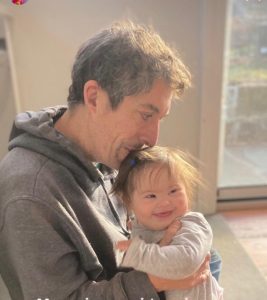
In what ways has your experience with your brother influenced the way you advocate for your daughter?
My experience with my brother has been much harder, and more complex because of lack of knowledge played out over many years. The mainstream medical community tend to treat people like my brother with merely run-of-the-mill tests that don’t pinpoint his needs. Through his life I have seen him be constantly affected by diagnostic overshadowing, not being treated effectively medically, because every issue that presents was treated as ‘incurable’ or not worth investigating too much. It’s awful.
In the end, some of this is because he was born at a time when they weren’t doing this research, or this research wasn’t available yet. However, people can still fall into the same kind of gap if the professionals around them simply aren’t in touch with the guidance out there that can help. That gives me a strong desire to make people aware that they should not go along with a message of accepting the status quo.
I have discovered the importance of medical practitioners who care about their patients, and are up to date on the research and invested in participating in it. I’m incredibly glad that my daughter was born in a time where this research is within our reach.
The difference it makes is before my eyes all the time, because with my brother, I am constantly dealing with someone who has challenging health and behavioural issues. I know now that a lot of his patterns are also biochemical. It wasn’t until my daughter was born and we started getting help for her, that I could fully realise the range of things my brother missed out on. It makes my heart ache that he couldn’t have received these investments earlier to alleviate some of his struggles. Every day I see the difference between someone who has reached adulthood without access to this research, versus my daughter who is benefiting from it as early as possible.
What did your family know about your brother’s condition?
When my brother was born in the 1970s, the medical professionals didn’t identify his syndrome or condition. They didn’t do a karyotype to study his chromosomes: instead he was labeled as ‘brain damaged’, and the doctors just said, ‘he might not live past three years old.’ It was a dismissive and effectively negligent attitude. He is now almost 50 years old. My family had to wait until my brother turned 14 years before they discovered that he had Williams syndrome. That was a very long time for my mother to be wondering what was happening with her child, with no direction to look for treatments. Since he was dismissed as ‘just brain damaged’, my mother tragically had no support from the medical profession: no one looked at how his condition affected him medically and what could be improved for him.
My daughter was born after my mother developed Alzheimers, so we have never been able to discuss the shared experience of bringing up a child with special needs. If there’s one thing I wish I could talk to my mother about, it would definitely be about her journey with bringing up my older brother. In previous decades, parents didn’t have the support that we have today, and I experience that reality with great empathy now: I think my mother went through a frustrating struggle that must have been very isolating.
As a parent, I’m so grateful to have my daughter at this point in time, rather than bringing up a child in the ‘70s when a shift was just starting to happen. Before that, children born with disabilities were frequently sent straight from hospital into lifelong institutions. When parents refused to go along with that pathway, and started taking their children home, more advocacy efforts sprang up to protect their rights. However, although parental attitudes shifted, medical research and other supports were not extensive.
By ‘support’, I particularly mean knowledge of the medical foundations of how to improve the lives of people with disabilities. My brother had none of these benefits. With Williams syndrome, he has some similar medical outcomes to Down syndrome. He has hypotonia, speech issues, airway issues, heart defects (he had a hole in his heart), and cognitive or intellectual disabilities. However, it was not unclear how to offset some of the challenges he faced. We were never really given reason to imagine that anything could be done.
Do you think things could have been different for your brother?
Yes. There were so many interventions that truly could have improved his life.
His speech is very poor, and also his breathing. At night he has developed bad sleep apnea but he has struggled to adapt to the sleep apnea machine. He has a very narrow palate and an underbite, which does not help his speech. He went through speech therapy for years, yet because of his mouth shape he cannot speak well. If he had been given a palate expander as a kid, it would have made a big difference. My mother had taken him to an orthodontist to look at his palate, but they dismissed the need to treat it, saying, ‘it’s not worth it, he’s not going to tolerate anything.’ They acted as though my mother was looking for a cosmetic treatment, but this was something treatable that has now affected his whole life. An intervention would have fixed his underbite, and created a larger airway so he could speak better, and he could breathe better. If he had been breathing better at night all these years, it would most likely have improve his behaviours and all other indicators of wellbeing.
Research now shows how important sleep is, and it’s just one example of how huge the difference is to me, comparing someone like my brother who has reached adulthood without access to this research, versus my daughter who is benefiting from it as early as possible. We already know what to pay attention to for her: for example, at a certain age, we’ll make sure she has a palate expander, and we are following a recommendation that before the age of four, she should have a sleep study to make sure she doesn’t have sleep apnea. All these things will improve her life and her health, and we know it will help because we now have proof of what works and what doesn’t.
My brother has now also seen Dr Erica Pierson, and has received vitamins and supplements that can definitely help him, and he has switched some medications. However we do experience that a window of opportunity has been missed, as at the age of 50 he is ingrained in some behaviours and patterns. Other important things have also been caught: for instance his thyroid medicine wasn’t working. My brother was anaemic as a medication he was taking was blocking his iron absorption. The regular doctors simply aren’t checking for that, or have ignored these issues.
My brother has made some recent improvements, but it’s sad that he had to wait until middle age to find suitable adjustments. Early interventions are much more effective.
Upcoming: Part Three: “An emotional load was lifted” – hope for the future of children with Down syndrome