The transcript from the Researcher Chat video here is edited for readability. Dr Elizabeth Corcoran speaks with Professor Emily Farran (University of Surrey) and Dr Laura Cristescu (University of Birmingham, previously postdoctoral researcher at University of Surrey) about their recent project, the ‘Shape Research, Change Lives’ study.
Dr Elizabeth Corcoran
Hello and welcome everybody to one of our Researcher Chats. I’m really excited that I am joined by two of the researchers of a piece of research called ‘Shape Research, Change Lives’, here to talk to us today about their work and what they found out. I’m joined by Laura, one of the researchers, from University of Birmingham. Tell us a little bit about yourself, Laura.
Dr Laura Cristescu
Thank you so much. I’m very excited to talk about the ‘Shape Research, Change Lives’ study which I was a post-doctoral researcher on. I conducted the data collection and the collaboration with our advisory and steering groups.
Dr Elizabeth Corcoran
Excellent. And we’re also joined by Professor Emily [Farran]. Hello Emily. Where are you based?
Professor Emily Farran
I’m a professor of cognitive psychology at the University of Surrey, and I was the lead on the ‘Shape Research, Change Lives’ project. I’ve been working with people with Down syndrome for a long time, probably about 20 years now. We really wanted to do this piece of research because a lot of our responses to what people wanted research to be on was quite anecdotal. We wanted to do a study where we could in a very systematic way have a good understanding of what research the communities of people with Down syndrome wanted to be conducted.
Dr Elizabeth Corcoran
Thank you for both being here today.
We have these Researcher Chats to help people to understand researchers are normal people: they want to talk to you about your life, they want to understand what’s important. And that’s actually what this very study was about. So Laura, Emily, and the rest of the team looked at what priorities people have around research.
Can you give a summary of your study, and why was it important to do this work?
Professor Emily Farran
We have a lot of chats with the people that are taking part in our research, and from those chats we got an understanding that there wasn’t much of a voice from the community to talk to researchers, or funders, or people that make decisions about research: to express what research they thought should be carried out.
I think it was important to do this: to ask the community, and to make sure we were accessing everybody in the community. We worked with three different genetic conditions: people with Down syndrome, but also people with William syndrome and Fragile X syndrome. We made sure that we talked to the people with Down syndrome themselves – and not just adults: we included children as well, because children are often underrepresented in research.
We talked to their families. We also talked to practitioners, and to researchers. We worked with these particular conditions, because in terms of the broader community of people who may have learning disabilities, people with Down syndrome, and Williams and Fragile X syndrome, have a definitive diagnosis. They may be diagnosed even before birth: but at least at birth. That meant we could speak to research that would be relevant right from birth, through to the end of the lifespan and adulthood.
We had two different parts of our report. The first part of the report involved us looking at the research that had already been carried out. We looked at the last 10 years, and we focused on the UK because the communities we were going to be working with were from the UK. We looked at all of the publications of research that were out there over the last 10 years, and we looked at what the research was on, and how much of it there was. We also looked at what research was being funded.
We found there were about 600 journal articles – published pieces of research – and 26 million pounds worth of funding in that 10-year period. And when we classified the areas of research that were being conducted, we found that the majority of the research was on what we’re calling basic research – thinking about the processes that relate to the brain, or processes to do with biology, or to cognition. These are all things that are very important.
But equally, when we looked at areas that may have a more direct implication for the communities of people with Down syndrome – things like societal issues, treatments and interventions, the effectiveness of different services – there was a really, really small percentage of studies that were receiving funding or where there had been research on it.
I’ve got the statistics here: so 5% of the research was on treatments and interventions; only 3% on services; and then less than 1% of the research was on lifespan issues.
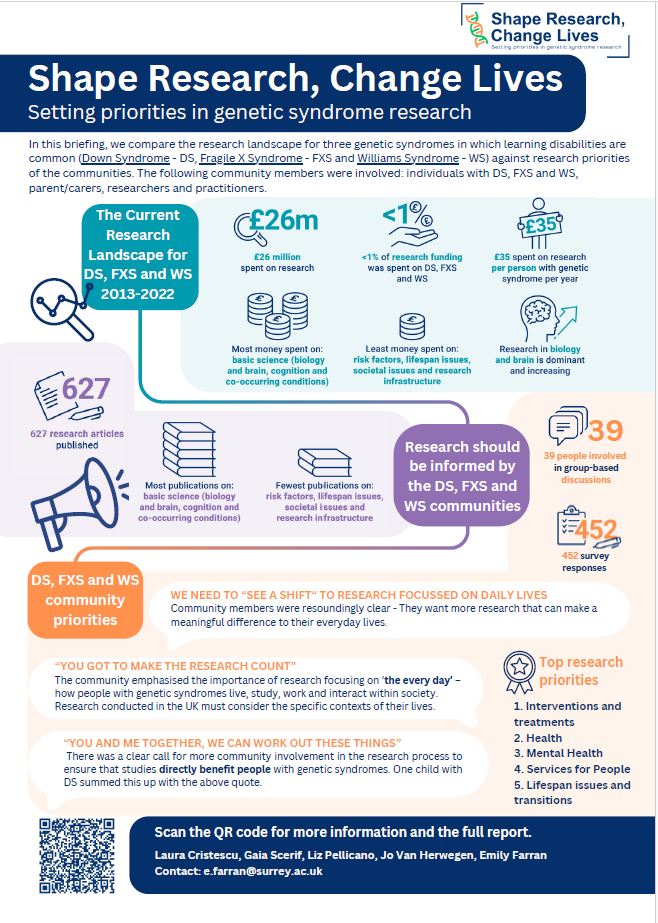
Then, having understood what this profile of research looked like, we went to the communities. Laura and I absolutely love this part of our report. We worked with people via questionnaires and also through focus groups and interviews. About 500 people completed our questionnaires, and then Laura worked with people through focus groups and interviews: I think there were about 40 people that took part in those. Again we made sure that we talked to everybody – from children, to adults, to practitioners, to researchers, to parents. We asked them: one, what did they think of this research profile, but second (and I think most importantly), what did they want research to be on: what were their priorities for research.
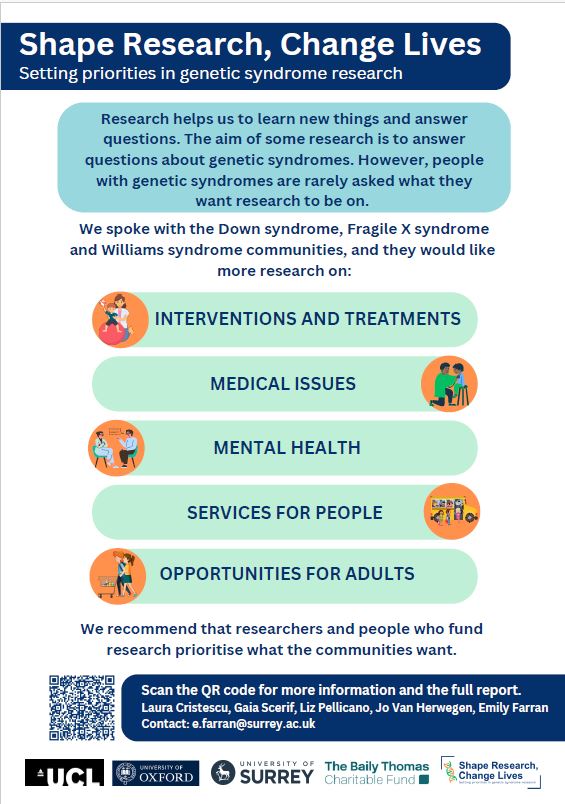
The top priority for them was treatments and interventions. So, more research on treatments and interventions – and if you remember, that was one of the areas which had the least amount of research. The next area was related to health and medical issues; and then also mental health for people with these genetic conditions.
There was also a strong emphasis on services. So thinking about doctors and teachers and social workers and how these services can be most effective for people with Down syndrome and other genetic conditions.
Of the top five the last one, which I think is a very important one, was about what the future holds. So lifespan issues, transitions to adulthood, employment, housing, all of those sorts of issues. In fact, that particular priority came up very strongly in our focus groups as well, as something that people were felt was an area that we needed more research on. And again: if you remember, less than 1% of the current research was on that area.
So, we also asked the communities, what do you think of the research profile? We’re asking you about your priorities, but here’s what is actually being conducted.
70% of the respondents said that they weren’t very satisfied with the current research profile. It’s not that they thought that the basic science shouldn’t happen: they very much saw the importance in that. But they wanted more of a balance. They wanted the more direct things, that would directly influence their lives, to have a slightly higher weighting.
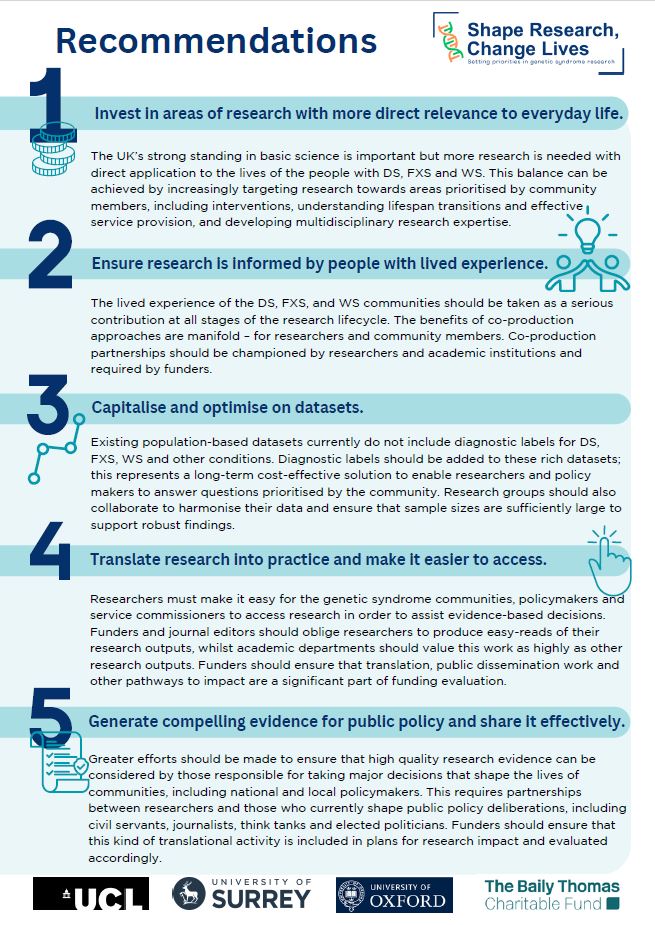
From that report, we put together lots of recommendations. Recommendations that policy makers might be able to use, or funders, but also recommendations that we hope would speak to the communities as well.
Our first recommendation was about readdressing that balance: making sure that there was research not just in basic science, but also a higher proportion of research in the areas that matter most, in the priority areas that came from the communities.
We also recommended that people with Down syndrome are actually part of the research process. Laura is going to speak about that later on, in terms of the efforts that we made to make sure in ‘Shape Research, Change Lives’ that we really were including the community all the way through.
We also recommended that the research is actually easy to find. We obviously were looking at journal articles, but these aren’t necessarily written in a way that communities can find, or make best use of them. We really recommended that any researchers conducting research should make sure that they report the findings in lots of different formats, so that they’re accessible to all the different groups of people, which includes the communities of people with Down syndrome.
Also we talked about people that make decisions: policy makers and local authorities who are being asked to make decisions, and need an evidence base to help them to make those decisions.
That’s a summary of what we did, we’re happy to ask answer any questions as well.
Dr Elizabeth Corcoran
First of all, thank you so much for doing this research. As someone who’s running the Down Syndrome Research Foundation, we’re so thankful – because we’ve been running for 30 years, and I can 100% agree with everything you’ve said. The problems that we’ve seen around interests being only in the science side, and not enough researchers or funders looking at how we can translate those findings into testing and looking at what helps people to live better lives.
And secondly, as a doctor, I recently contributed a small part to a paper about lifespan approaches for people with Down syndrome. We, as a team who wrote that paper for The Lancet Journal, felt strongly that we need to start thinking: this condition is something that people live with, and we need to have a lifespan approach.
As a sister as well, thank you so much for doing this work. As someone who’s caring for someone who has Down syndrome, you want to see the doctors, nurses, and people who look after them feeling confident: that they know what will help, and what won’t help, and for us to know what kind of changes to support your loved one in, to help them to stay healthy for as long as possible. So, thank you guys.
Also, I was thinking about the funders, and like you say, they should have a duty to help fund the most important research – and now we have the voice of the community backing up their wants and needs, to help focus on how to best spend that money. So, thank you.
Laura, let’s go to you, and think about co-production. We’ve talked about co-production on our previous research chats with other teams, in particular University of Kingston and their KIND research group. So, what is co-production for people, and how can it make a difference when we talk about aligning research priorities?
Dr Laura Cristescu
Co-production has become something that’s very often used nowadays in research, and it’s become a bit of a buzzword, but I would simply understand it as ‘doing research together’. It’s come from moving away from research being done to people, to research being done with people, the people that research most impacts. We know that there there’s growing recognition that research becomes stronger and more relevant and more impactful when the people that are most affected by its outcomes are actively involved in shaping it. So it’s about that active rather than passive involvement in research. We know that this is also increasingly recognized by research funders which is really great to see.
However, despite this growing emphasis and attention on co-production, it remains relatively uncommon in research involving people with learning disabilities, especially when it comes to involving children and young people. We know that their perspectives are often underrepresented in discussions about research priorities and in co-produced research, so one of the motivations in our study was to begin addressing this gap, and we wanted to create opportunities for people with Down syndrome, Fragile X syndrome and Williams syndrome – including children and young people – to contribute directly to setting those future research agendas.
We know that too often research priorities are determined by funding trends, or researchers, or clinicians. We felt that it was very important that individuals with lived experience and their communities had a genuine voice in identifying the questions that mattered most to them, and we recognized that if we wanted to hear those voices in a meaningful way, we needed to work closely with the communities themselves throughout the research process, as Emily mentioned.
To do that, we had advisory groups: one of adults with the three genetic syndromes, and then one of parents and carers, as well as a steering group, and they play a central role throughout the project. They worked with us in developing the focus group and the questionnaire questions – the exact wording and the layout – but also informed decisions about how the data collection was conducted.
We did online focus groups, and they helped us to shape that process in terms of how we could put participants at ease; making them comfortable; helping them to understand what research is, and what research participation entails; and then they also contributed to our recruitment material. We gathered participants to our research, and also the dissemination plans, and they contributed to that dissemination, so getting the findings of our research out.
What we really wanted to emphasize through this co-production and collaboration process was that this process would be meaningful to our collaborators, our advisory and steering groups. For this we invested time in really understanding people’s previous experiences of research, discussing their expectations from the collaboration, and also spending time building relationships and getting to know our collaborators, as well as regularly reflecting on how that collaboration was working, and whether there was a need to change anything in our ways of working together. I think that was really fundamental to the success of the project, and being able to gather so many voices to our priority setting exercise.
I think one key message from the ‘Shape Research, Change Lives’ study is that co-production is not just about involving people after the research questions have been asked or have been decided. It’s about sharing power. That’s something we discuss a lot in our papers as well: sharing power in decision making. It’s about building trust and creating processes that enable people to shape the research from the outset, and be involved throughout that process. That was crucial to the development of our study.
Dr Elizabeth Corcoran
Thank you. I often reflect when I’m challenged to do co-production, when we’re putting working together, I often think, ‘I’m training the these advocates to learn what research is’ – but actually, I find that there’s so much learning that goes on from the researcher side.
We’re so used to using lots of words to say things, but actually it’s quite a challenge to think: what is the core of what I need to communicate here? and going back and forth with them, and both of us learning and becoming better: them as they grow in advocacy and as researchers in co-production, but you as the deliverer, to figure out what to cut that doesn’t matter, and what’s the real ‘meat’ of this question. So thank you Laura, that’s really helpful.
I noticed that sleep research is becoming a really important priority area, and we have spent a lot of time setting up (two years ago) the Down Syndrome and Sleep Research Network. It’s a very common need being raised among families and people with learning disabilities and Down’s syndrome, and also researchers wanting to work in this area, so we are really investing in that area. Did sleep research and those kind of interventions come up in your work? It touches different areas doesn’t it?
Professor Emily Farran
Yes, it did in some ways, but because of the way that we were conducting this research, the kind of level of detail wasn’t as detailed as ‘sleep research’ specifically, but in terms of the five priority areas, sleep research would be relevant to many of them. It’s related to health, and improving people’s sleep is related to treatments and interventions. I think implicitly it was there. Also, we know that improvement in sleep has lots of different downstream impacts: if you have better sleep then you’re better able to learn, to function better, it might have implications for mental health. In that sense it’s it’s very relevant to our studies.
It did come up a little bit in some of the focus groups: Laura and I were just looking at the focus groups, and there was a quote from a parent of someone with Down syndrome talking about how their child had been given melatonin as a treatment for sleep, and they were questioning, is there actually an evidence base for this being effective for people with Down syndrome?
It was something that was very important within our focus groups, but not quite at the level that we would expect it to come up [alone] in any of the main priority areas: it’s just relevant to most of them in fact.
Dr Elizabeth Corcoran
Yes. Everyone feels better when they have a good night’s sleep.
I really like that the voice of the community highlighted mental health. My background is in psychiatry and it’s a massively poorly understood area generally for those with learning disabilities. A lot of times we see it through the lens of managing challenging behaviors, and actually behavior is communication for maybe underlying mental health issues and distress. It’s not very well understood, and I think we have far to go as clinicians. So please, researchers, if you want to look at that area, now is your time! We’ve got a clear need that the community has identified.
Hopefully you are aware of the news: we are really excited the Down Syndrome Act 2022 passed, and we’re in disability rights month – and it made history that this law was passed. Alongside that law are the statutory duties: duties that the government will have to fulfill in the guidance that goes with that law, and it will come into full effect soon, hopefully.
How can researchers design their studies so that local authorities and ICB boards can easily use the findings to meet their legal obligations under the Down Syndrome Act 2022? How can your research impact that?
Professor Emily Farran
Yeah, thank you for bringing that up. I’m going to talk a little bit about some of the aspects that I think are important, and then we’re going to move on to Laura, who’s going to give a response to this question as well.
We have the draft guidance at the moment, and something that I wanted to bring up is that there’s a lot of conversation in there about preparation for adulthood. So, looking at a quote that I brought out from that draft guidance: “From year nine onwards, local authorities are going to take annual reviews which focus on preparing for adulthood and independent living”: that very much aligns with the research priority that came out from ‘Shape Research, Change Lives’, about lifespan issues and transitions to adulthood and independence.
One thing that is an opportunity of the Down Syndrome Act for researchers is that all of the decision makers, the local authorities – they will want to make their decisions based on an evidence base, yet we’ve shown that much of that evidence base isn’t there when it comes to services, and when it comes to transitions to adulthood, etc.
I think there’s an opportunity not just to think about making the decisions, but about how those decisions are made, so that people understand what approaches work, who they work best for, what context they work best for, at what age they might work best. Thinking about the transitions to adulthood: are approaches that are done in year nine then going to have that impact that we want in adulthood? We won’t know the answer to that unless people are going to research this and measure the impact of the approaches that the local authorities take to address that need.
The other thing for researchers is going back to the recommendation that we had in our report related to accessibility. Decision makers need access to the research findings in a way that helps them to make those decisions. This is a call for researchers to think when you are conducting research that could be relevant to policy makers or any other decision makers, to make sure that you produce a report which helps these people make their decisions, making it accessible to those groups. I’ll hand over to Laura now to talk a little bit more about some of the things in the report about housing.
Dr Laura Cristescu
I wanted to pick up on a couple of things in the statutory guidance. Something that stood out to me mentioned mental capacity and supported decision making, and the rights of people with Down syndrome to have choice and control over their own lives. The guidance clearly states that capacity should never be assumed on on the basis of a diagnosis, and that people should be supported to make their own decisions wherever possible.
As Emily mentioned, research has an important role to play in understanding how to best do this in practice, and we need to grow that evidence base on the types of approaches, and services and environments. We need to find how we can support people with Down syndrome to exercise that meaningful choice and autonomy across different areas of life.
Something that closely reflects what we heard in our research: children, young people and adults with Down syndrome spoke very passionately about their aspirations for the future, including living independently, living with friends, having greater choice and control over where and with whom they live, and accessing meaningful employment. These priorities strongly align with the Act’s emphasis on preparing for adulthood, independence, and community participation. Whilst the guidance tells organizations what they should aspire to achieve, we need much stronger evidence on how best to achieve these outcomes in practice.
Housing is a good example, because the guidance emphasizes that people with Down syndrome should be able to choose where they live, with whom they live, and the type of support they should receive. Future research should not only look at types of housing provision, or the housing provision itself, but also whether different housing models support the outcomes that people value, such as autonomy, relationships, belonging and quality of life.
Similarly in employment, we need more evidence on the types of supports and opportunities and pathways to support people with Down syndrome to access rewarding and sustainable work. To go back to my point earlier, it’s important that these questions continue to be explored through co-produced research, and people with Down syndrome should be directly involved in defining what those successful outcomes look like, whether that’s independent living and meaningful employment, or broader quality of life.
It’s important that if the Act is to deliver lasting change, we need research to evaluate not just whether these services are meeting the statutory duties, but whether they are helping people achieve the aspirations and the goals that truly matter to them.
Dr Elizabeth Corcoran
Yes, absolutely. I couldn’t agree more. When we were collating the evidence database, the lack of evidence around social care approaches was really evident. I do think our colleagues in social care and learning disability teams need support around how to navigate helping adults make these decisions instead of seeing that they have certain provisions and forcing the people under their care into living situations that they wouldn’t have chosen themselves, if they had been supported through decision- making. So thank you. You have really hit the nail on the head there with that one.
Let’s move into thinking about funding. Charities are always out asking for money – and if anybody wants to donate, you can! We are open to your donations at any time. When you think about funders trying to look at the landscape and assess where the need is:
how can we as a charity, and other organizations like us, collaborate with groups like yourselves to lobby key research funders that have big pots of money? How can they actively rebalance the funding models and understand the need to move to research that is translational?
That’s a fancy way of saying ‘research that can change the quality of people’s lives’. How can we work together to help those guys that have the money sitting in those pots to spend it in a different way?
Dr Laura Cristescu
Absolutely. Thank you for that question. Just to reiterate what you were saying: one of the strongest messages from our priority setting work was that people with Down syndrome and their communities want research that has that tangible impact on their everyday lives. While we know there’s been investment in understanding the biological and genetic basis for Down syndrome, our findings suggest that communities are also looking for that greater investment in research, focusing on areas with direct impact on on their lives.
Organizations such as yourselves are uniquely positioned to help communicate those priorities, and to help keep them visible, and keep that conversation going. As you know, publishing the findings is only the first step, and there’s real value in continuing to share and discuss the results across research funding and policy communities as well, so that these priorities remain at the forefront of future decision making.
Opportunities such as this discussion today are really important in keeping that conversation going, and part of that process, because you help bring back those findings into the conversation and remind people what the communities told us, and ensure that those priorities hopefully begin to inform decisions about where that funding is directed.
It’s great to see that there is alignment in terms of our findings and the findings of your recently published papers as well around health inequities, and continuity of healthcare pathways, and quality of life, and looking at lifespan access to support. It’s great to see because we are building that growing evidence base, and then hopefully that will make an even stronger case to funders and policy makers.
Dr Elizabeth Corcoran
Absolutely. Thank you Laura.
So – thinking into the future, if we were going to invest in a new research initiative tomorrow (if some very rich person knocks on my door right now and gives me a big bag of cash) –
what kind of specific everyday life gap that you found in your report do you think is the most critically urgent and ripe for immediate funding?
Professor Emily Farran
We’ve already spoken about the importance of lifespan issues and transitions, and that very much aligns with the Down Syndrome Act as well. It was something that came up in both the questionnaire that we ran, and the focus groups too. But we also need to think longitudinally: tracking people over their lifespan.
There is definitely merit in thinking more about the number one priority that came through, which was treatments and interventions. In terms of funding, we need to think long term, so treatments and interventions. I work in developmental psychology and I’m quite focused on schooling and the educational landscape, and there was a meta analysis last year. That’s is when someone trawls through all of the research to find out what’s out there that’s answering a particular question. It was asking about educational interventions for people with Down syndrome, and there are only six – just six internationally. We’re not just talking about the UK here. When you look at those interventions, they’re not brilliantly funded either. So of the six, four were about reading and two were about mathematics, and many of them had quite small sample sizes, under 20 participants, which makes it difficult to really be confident in the findings of the research.
I do think one area for investment would be on educational interventions, and not just about the intervention for the children. It’s about thinking about the resources and the guidance and the professional development that practitioners might need as well, to help to deliver that intervention. It’s also about thinking long term about the outcomes. We don’t want to just be thinking about reading and maths, we want to be thinking about how that links to these lifespan issues.
Longitudinally, if children have taken part in these interventions while they’re at school, what is the long-term impact on that? Does it have a positive effect on their transitions into adulthood? This is a really big ask because it’s thinking about the entire lifespan, but I think it’s really important that we have this longitudinal data, tracking people through, to see the full effectiveness of different kinds of interventions.
It’s important to think about what can be embedded into classrooms rather than it being standalone interventions. How can it work in the child’s classroom, in the support system that they already have, so that it has the strongest opportunity to be scaled up and to be used more broadly across the Down syndrome community. I guess I’ve given two answers, because I’m thinking about treatments and interventions, but also how that impacts on the other strong priority about lifespan issues.
Dr Elizabeth Corcoran
Yeah. And you know, Down syndrome recently being added into the school census is giving us new opportunities to track and watch how these kids are growing up, and how they’re doing in different areas of the country that do hopefully bring some of these interventions into the classroom.
I often think about these roadblocks that people with Down syndrome have had in their in their way historically, and how they’ve been lifted one by one. Blocks like not being allowed to have their hearts repaired – finally that was lifted. Not being allowed to go to school – finally that was lifted. Then we become aware of the next ceiling that we need to work on, and the next. And that’s keeping them healthy and well, and not setting expectations that are too low, but giving children as always the opportunity to reach their best.
Thank you both for being with me today, and answering these questions from the community. I love the quote that you guys have on your little fact sheet on the results from one child with Down syndrome, that said “You and me together, we can work out these things”. I couldn’t have said it better, because that’s exactly right.
So the person sitting listening to this right now – that includes you – you’re a part of how this research can reach other people and change lives. Thank you both for being with me and talking about this great study.
Professor Emily Farran
Oh thank you for having us and giving us the opportunity to really speak to the community about the work that we’ve conducted, it’s really important to us, so thank you.
Dr Laura Cristescu
Thank you so much for having us and for keeping the conversation going.
Find out more: To access and download Easy Reads and summaries: https://www.surrey.ac.uk/shape-resear…
Read the full research report: https://research.birmingham.ac.uk/en/…
Professor Emily Farran – University of Surrey https://www.surrey.ac.uk/people/emily…
Dr Laura Cristescu – University of Birmingham https://www.birmingham.ac.uk/staff/pr…